 Marika
A server in London can reach an exchange hosting location in London in approximately 1 millisecond.
Reaching Tokyo from the same server can take 215 milliseconds over standard network routes.
But here is where things get interesting: without moving either endpoint, changing the network path can bring that 215 milliseconds down to 137.7 milliseconds.
Same cities. Same destination. A 36% reduction in network round-trip time.
When building low-latency crypto trading infrastructure, choosing the right market data provider is only part of the equation. Geography, network routing, exchange hosting locations, and data processing all influence how quickly information reaches your trading engine.
Using data from the CoinAPI Latency Route Map let’s explore real network measurements, regional infrastructure differences, private connectivity, and how to properly benchmark crypto market data latency.
1. Crypto Market Data Latency in Numbers
CoinAPI maps network connectivity between its points of presence (PoPs) and the infrastructure locations hosting major exchanges.
The infrastructure dataset, last reviewed on October 21, 2026, includes:
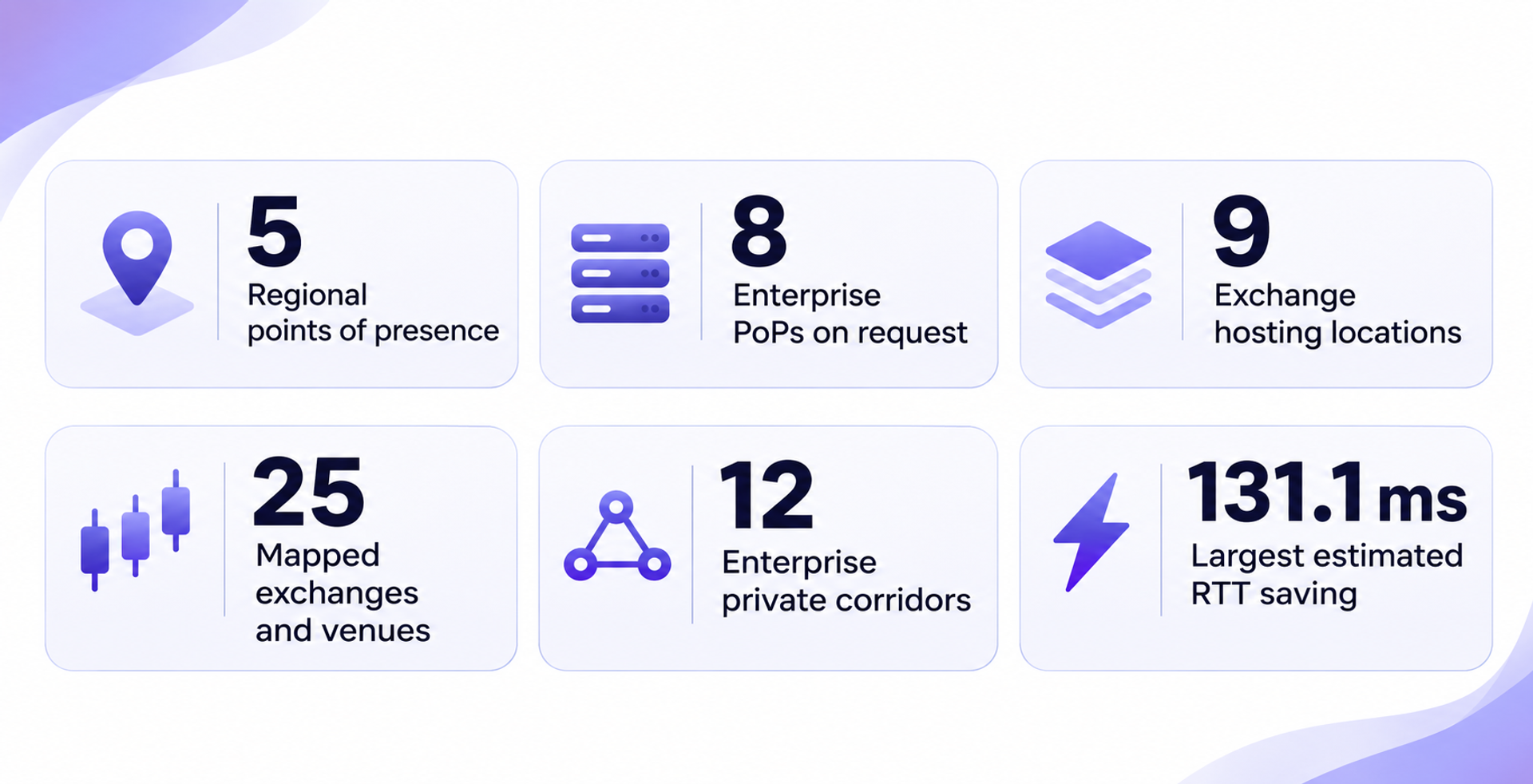
The dataset reveals three important findings:
- Geographical proximity is one of the biggest factors influencing network latency.
- Public network routing can introduce substantial additional delays beyond those imposed by distance.
- Private connectivity can significantly reduce intercontinental latency, although the improvement varies by corridor.
Importantly, these figures represent network round-trip time (RTT), not end-to-end market data delivery latency.
2. Where Does Crypto Market Data Latency Come From?
When traders discuss latency, they often refer to several different measurements as though they were interchangeable.
They are not.
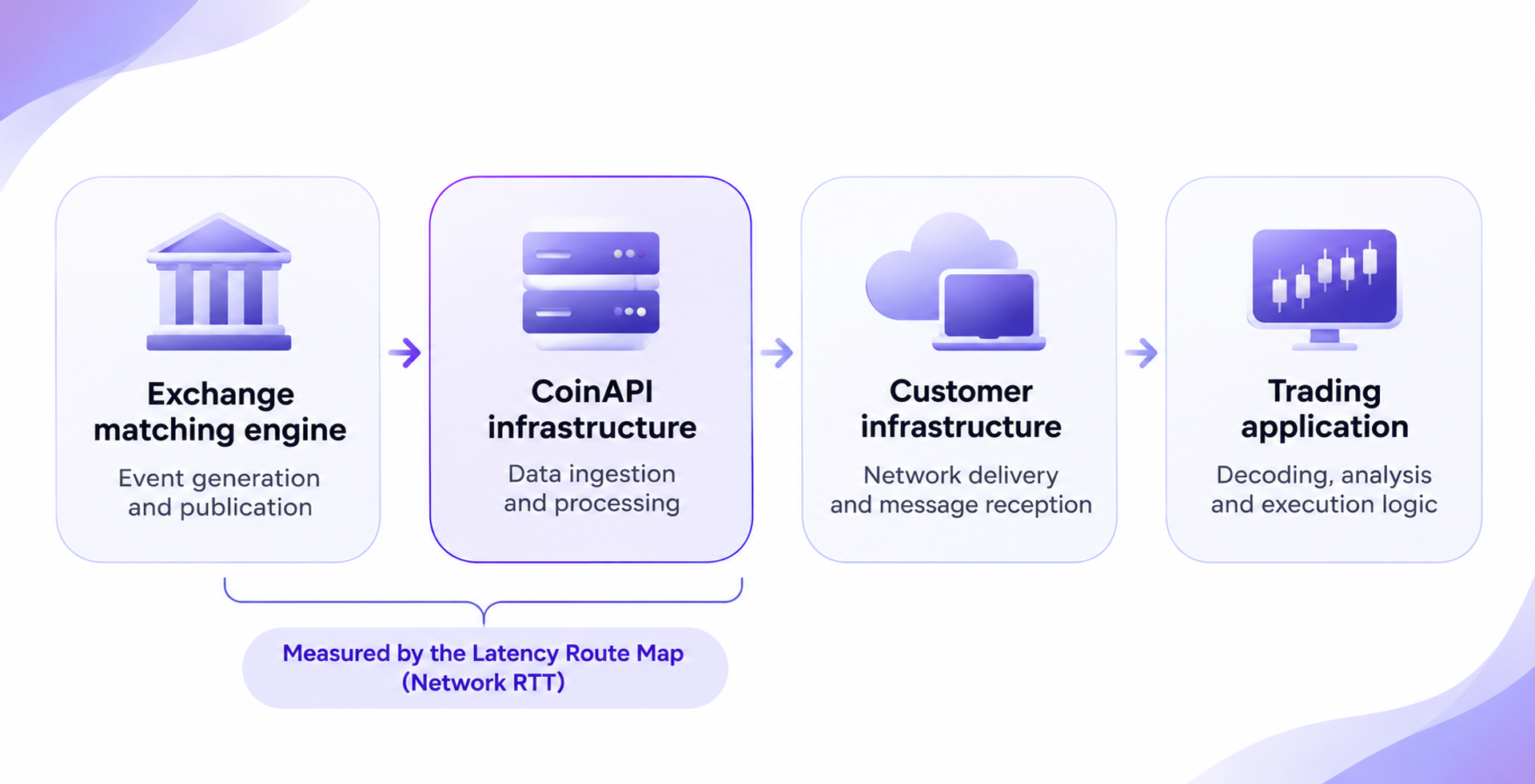
| Latency metric | What it measures |
| Network RTT | Time required for a network round trip between two endpoints |
| One-way network latency | Time required for data to travel in one direction |
| Exchange publication latency | Delay between an exchange event and its publication |
| Data processing latency | Time spent ingesting, processing and distributing data |
| End-to-end market data latency | Time between an exchange event and its reception by the client |
| Application latency | Time spent decoding, queuing and acting on received information |
A fast network connection does not automatically guarantee fast market data consumption. An overloaded application, inefficient message handling or a delayed exchange feed can introduce additional latency regardless of network performance.
Understanding which part of the pipeline you are measuring is essential before attempting to optimize it.
3. Geography Matters: Where Major Crypto Exchanges Host Their Infrastructure
The crypto market operates globally, but its underlying infrastructure is concentrated in a relatively small number of locations.
Tokyo, London, Singapore and Seoul are particularly important for crypto market data connectivity.
| Hosting location | Exchanges and trading venues |
| Tokyo | Binance, OKX, Bitget, Gate.io, HTX, MEXC, KuCoin, Hyperliquid, bitFlyer, Coincheck, bitbank |
| London | Deribit, Kraken, LMAX Digital, Polymarket |
| Sooul | Upbit, Bithumb, Coinone |
| Singapore | Bybit, Phemex |
| Frankfurt | Bitstamp |
| Northern Virginia | Coinbase |
| New York | Gemini |
| Ohio | Kalshi |
| Chicago | CME Group |
Hosting locations reflect the CoinAPI infrastructure dataset as of October 21, 2026. The mapped venues include crypto, derivatives and prediction markets.
Tokyo alone accounts for 11 of the 25 mapped venues. This concentration makes it an important infrastructure location for trading firms monitoring multiple Asian-hosted crypto exchanges.
For a quantitative trading team, the location of an exchange's headquarters is considerably less relevant than the location of its matching engine and market data infrastructure.
A globally distributed market does not necessarily require an equally distributed trading strategy. Sometimes, choosing one strategically located server can make a substantial difference.
4. How Much Does Distance Affect Crypto Market Data Latency?
Consider a trading infrastructure deployment in London.
Accessing European exchanges involves relatively short network paths. Connecting to American or Asian exchanges introduces an entirely different latency budget.
The following figures show standard network RTT from CoinAPI's London point of presence to nine exchange hosting locations.
Network RTT from London
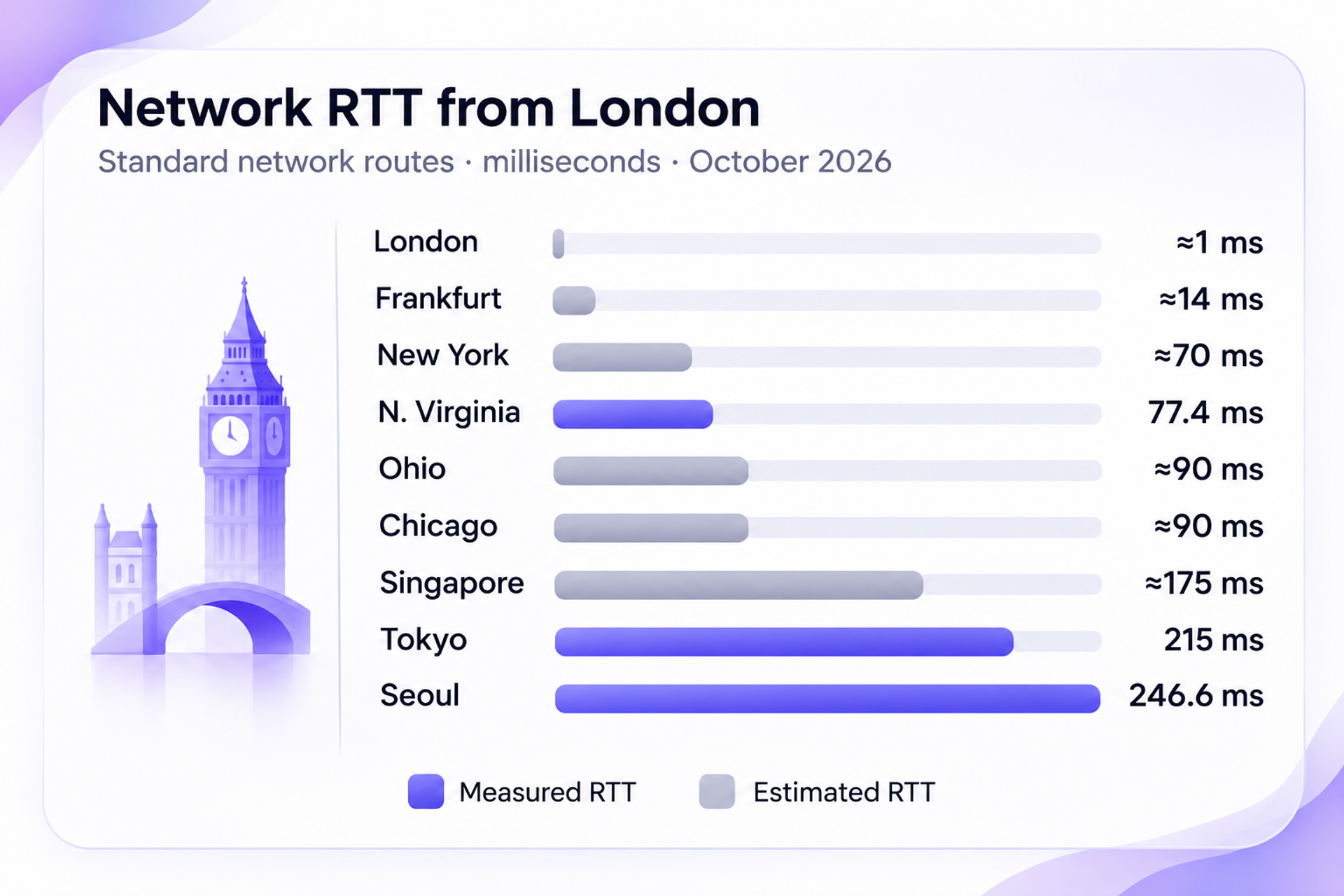
| Destination | Standard RTT | Measurement status |
| London | ≈1 ms | Estimated |
| Frankfurt | ≈14 ms | Estimated |
| New York | ≈70 ms | Estimated |
| Northern Virginia | 77.4 ms | Measured |
| Ohio | ≈90 ms | Estimated |
| Chicago | ≈90 ms | Estimated |
| Singapore | ≈175 ms | Estimated |
| Tokyo | 215 ms | Measured |
| Seoul | 246.6 ms | Measured |
The difference between reaching a local exchange and an Asian exchange from London is substantial.
For high-frequency trading, cross-exchange arbitrage and market-making strategies, these differences can influence infrastructure placement, signal freshness and execution decisions.
For historical research, portfolio analytics or slower systematic strategies, the same delays may be considerably less important.
There is no universally optimal infrastructure location. There is only an optimal location for a particular trading strategy.
5. Can Private Network Routes Make Crypto Market Data Faster?
You cannot move Tokyo closer to London. You can, however, change how network traffic travels between them.
Public internet traffic and cloud backbone routes are not necessarily optimized for the shortest possible transit time. Routing policies, interconnection points and infrastructure availability can introduce additional distance.
Dedicated private connectivity offers an alternative.
CoinAPI provides Enterprise customers with dedicated network corridors designed to reduce transport latency between infrastructure locations.
Fully measured private-route comparisons
The following five corridors have measured RTT values for both standard and Enterprise private connectivity.
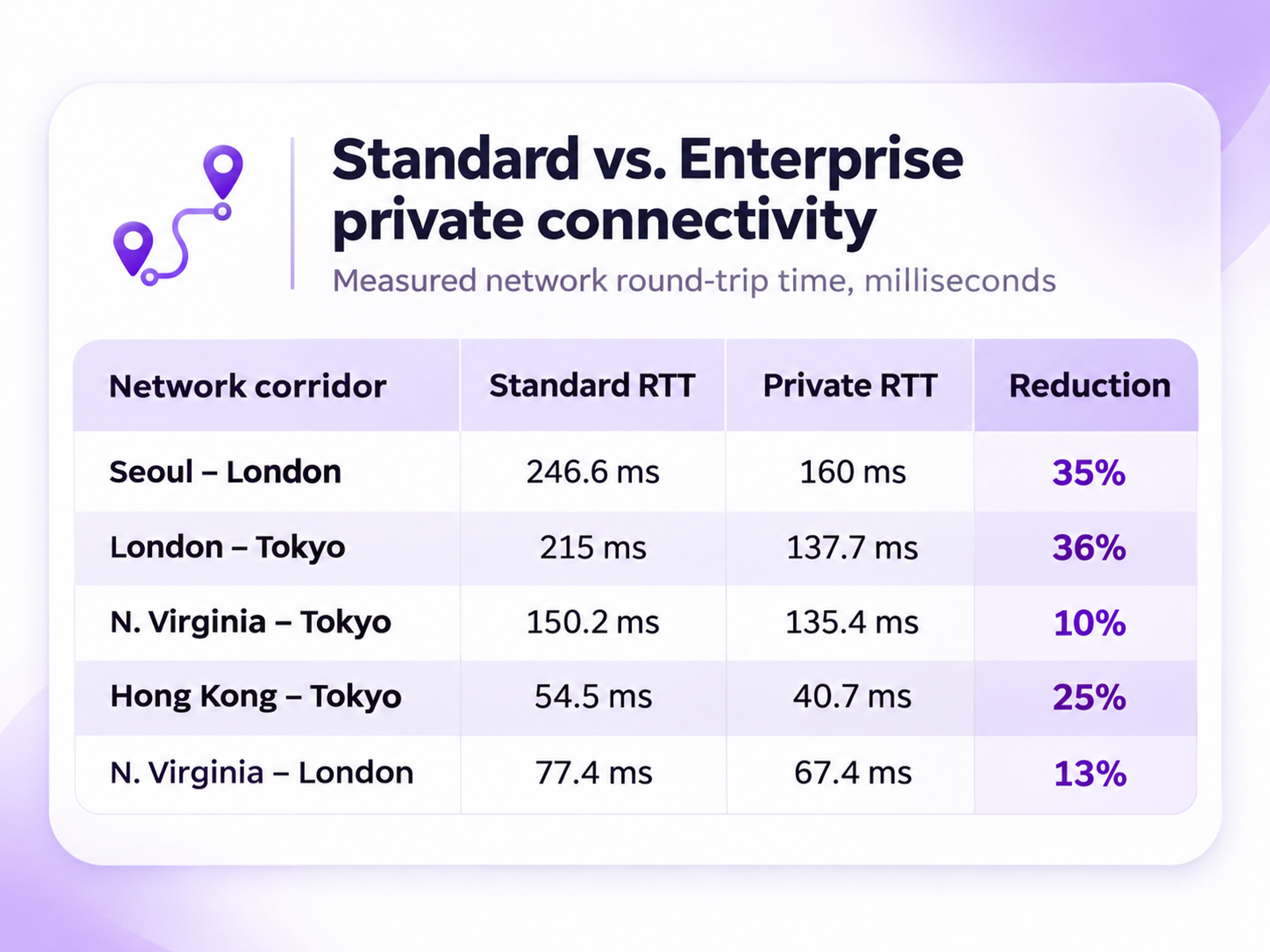
The largest fully measured absolute reduction among these corridors is 86.6 milliseconds between Seoul and London.
Interestingly, private connectivity is not exclusively useful for intercontinental routes. The Hong Kong–Tokyo corridor also shows a 25% reduction in measured RTT.
Additional private-route results
Seven additional corridors have measured private-route performance but currently use estimated standard-route baselines.
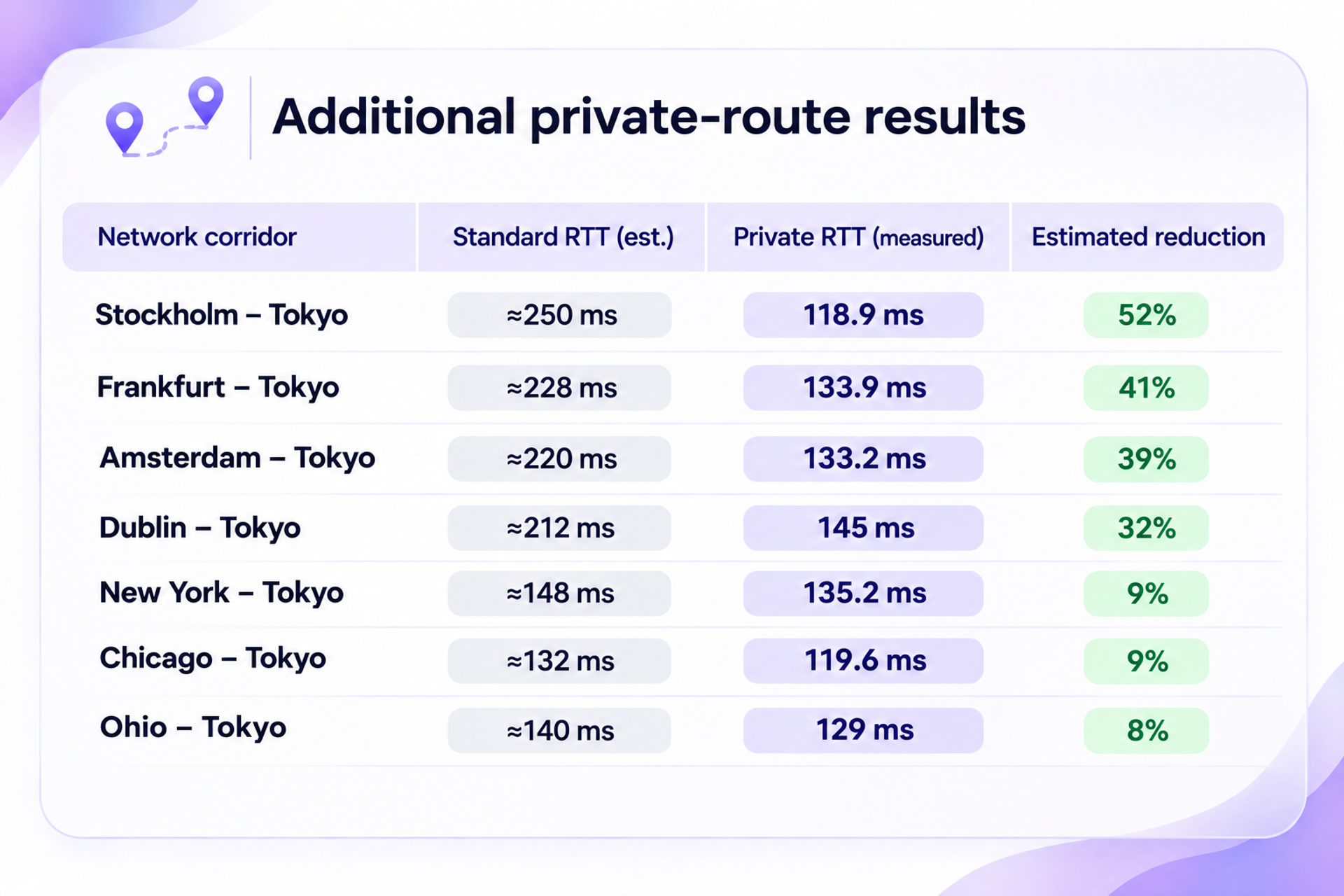
The Stockholm–Tokyo corridor illustrates the potential of optimized connectivity particularly well, with an estimated RTT reduction of 131.1 milliseconds.
However, because its standard-route baseline is estimated, the 52% improvement should be treated as indicative rather than a fully measured comparative result.
6. What 77 Milliseconds Actually Mean
A reduction of 77.3 milliseconds on the London–Tokyo route might sound insignificant outside electronic trading.
After all, it is less than one-tenth of a second.
But markets do not operate on human reaction times.
For market makers, quantitative funds and cross-exchange trading systems, additional network delay can contribute to stale order book views, delayed price discovery and slower responses to changing market conditions.
The potential benefits of reducing network latency include:
- Cross-exchange arbitrage: reducing delays when observing price discrepancies across venues.
- Market making: receiving market updates sooner to support quote adjustments.
- Order book monitoring: reducing the network contribution to data staleness.
- Risk management: improving the timeliness of incoming market information.
- Distributed trading systems: improving communication between geographically separated infrastructure.
These benefits depend on the complete system architecture. A 36% reduction in network RTT does not automatically translate into a 36% improvement in trading performance or end-to-end market data latency.
Milliseconds are valuable, but only when you know where you are losing them.
7. How to Access Crypto Exchange Latency Data
Infrastructure decisions should not depend on screenshots or static comparison tables.
CoinAPI makes the underlying Latency Route Map dataset publicly available in JSON format.
The response includes infrastructure locations, exchange mappings, standard network RTT, available private-route measurements and indicators distinguishing measured from estimated values.
Compare fully measured network routes using Python
The following example retrieves the dataset, excludes estimated measurements and ranks private corridors by absolute RTT savings.
This approach allows infrastructure teams to compare measured routes without mixing empirical observations with estimated baselines.
The dataset can also support regional infrastructure planning, automated comparisons and historical monitoring if snapshots are stored periodically.
Explore the complete dataset and interactive visualization: CoinAPI Latency Route Map.
8. How to Benchmark Your Own Crypto Market Data Connection
Network RTT provides a useful starting point, but real-world performance should be measured from your actual deployment environment under representative workloads.
Whether you consume market data through REST, WebSocket or FIX, monitor response times, message arrival delays, throughput, processing queues and latency percentiles (p50, p95 and p99). Ensure accurate clock synchronization when measuring exchange-event-to-client latency, and test performance during periods of both normal and elevated market activity.
CoinAPI provides practical testing instructions, tools and recommendations for identifying performance bottlenecks and optimizing data consumption across all three interfaces.
For implementation details, code examples and recommended testing practices, see the CoinAPI API Performance Testing Guide.
9. Your Application Might Be the Bottleneck
Before investing in dedicated infrastructure, check whether your application can consume market data as quickly as it receives it.
A fast network connection is of limited value when incoming messages spend tens or hundreds of milliseconds waiting in a processing queue.
Effective market data architectures separate message reception from processing, monitor queue growth, distribute heavy subscriptions across multiple connections and avoid blocking operations in the receiving thread.
When benchmarking latency, consider monitoring p50, p95 and p99 rather than relying exclusively on averages. Occasional delays can be particularly important during periods of high volatility, when message volumes increase.
If latency grows as message throughput increases, the problem may be local processing capacity rather than network connectivity.
Buying a faster network will not fix a slow consumer.
10. Test the Latency Yourself.
The best way to evaluate a market data provider is to put it to the test. From your own infrastructure, with your own subscriptions, under real market conditions.
Start with $25 in free CoinAPI credits and benchmark our market data delivery against your existing provider. Compare response times, streaming performance and data freshness to see what works best for your trading strategy.
Need something faster? CoinAPI Enterprise offers dedicated private network routes, additional points of presence and customized connectivity options for latency-sensitive trading systems.
- Get your free credits and start testing.
- Explore the Latency Route Map to compare network routes.
- Follow our Performance Testing Guide to run your own benchmarks.
Because when milliseconds matter, measurements speak louder than marketing
Frequently Asked Questions
What is a good latency for a crypto market data API?
There is no universal benchmark. Suitable latency depends on exchange location, client infrastructure, data interface and trading strategy. Local network RTT may be around a millisecond, while intercontinental routes can exceed 200 milliseconds before application-level processing is included.
Which location is best for low-latency crypto trading?
It depends on the target exchanges. Tokyo is particularly relevant for Binance, OKX, Hyperliquid and several other major crypto venues. London, Seoul, Singapore and Northern Virginia are important for other exchange ecosystems.
How much latency can a private network reduce?
In the CoinAPI dataset reviewed on October 21, 2026, fully measured private-route comparisons show RTT reductions of approximately 10–36%. Additional corridors indicate potential reductions of up to 52%, using estimated standard-route baselines.
Is network RTT the same as market data latency?
No. Network RTT measures a round trip between network endpoints. End-to-end market data latency also includes exchange publication, provider processing, customer delivery and potentially other processing delays. RTT divided by two is only an approximation of one-way network latency.
How can I test crypto market data API latency?
Measure performance from your actual deployment region using the intended REST, WebSocket or FIX interface. Monitor response times, message arrival delays, throughput, processing queues and latency percentiles under representative workloads.
Where can I download exchange network latency measurements?
CoinAPI provides a public JSON dataset at coinapi.io/api/latency-route-map, including infrastructure locations, measured and estimated RTT values, and available Enterprise private-route results.