 Marika
Two venues can quote the same pair at the same second and disagree by a full percent. Neither is wrong. One priced the trade off a liquidity curve. The other priced it off an order book. A third would have pulled quotes from a dozen providers and returned the best one. The short answer to “which crypto swap exchange is best in 2026” is nine names spread across those three pricing engines: SimpleSwap, Uniswap, Changelly, BYDFi, ChangeHero, StealthEX, Jupiter, Coinbase, and OKX.
This guide compares them by how they form a price, who holds the asset while it moves, what the fee page actually says, and what a developer can plug into. The numbered order is an editorial selection by workflow, not a measured best-to-worst ranking. The fingerprint scores below are editorial assessments of workflow suitability, not independent measures of quality, safety, or overall performance. Fees and product facts were checked on October 29, 2026 against each venue’s own pages, with BYDFi and StealthEX added on November 6, 2026, and volumes were refreshed on November 4, 2026 from DefiLlama and CoinStats’ exchange rankings. When a venue’s own pages contradict each other, both numbers are reported.
CoinAPI sits underneath comparisons like this one. It normalizes trades, quotes, order books, and OHLCV from 400+ exchanges and hundreds of thousands of symbols into one schema, delivered over REST, WebSocket, FIX, and MCP, and its DEX coverage includes Uniswap v2 and v3 swaps alongside the centralized books, with coverage that varies by dataset, venue, and symbol. That matters here because a swap quote only means something next to the market it was drawn from. The CoinAPI Market Data API returns the per-venue books, the Exchange Rates API returns a VWAP-24H reference across venues, and CoinAPI Flat Files hold the history. The price-quality notes in this guide use that frame: not the advertised rate, but the gap between the net quoted output and the executable market behind it.
Venue fingerprints: five traits, nine shapes
Each venue is scored 1 to 5, by editorial judgment from the documented facts in the entries that follow, on five traits: reach, fee clarity, custody, no-KYC access, and developer access. These are workflow profiles, not quality or safety ratings; a KYC requirement, for example, is an access characteristic rather than evidence of poorer service. Read the shape, not the area. A full pentagon is a venue that does a bit of everything; a single long point is a venue built for one job.
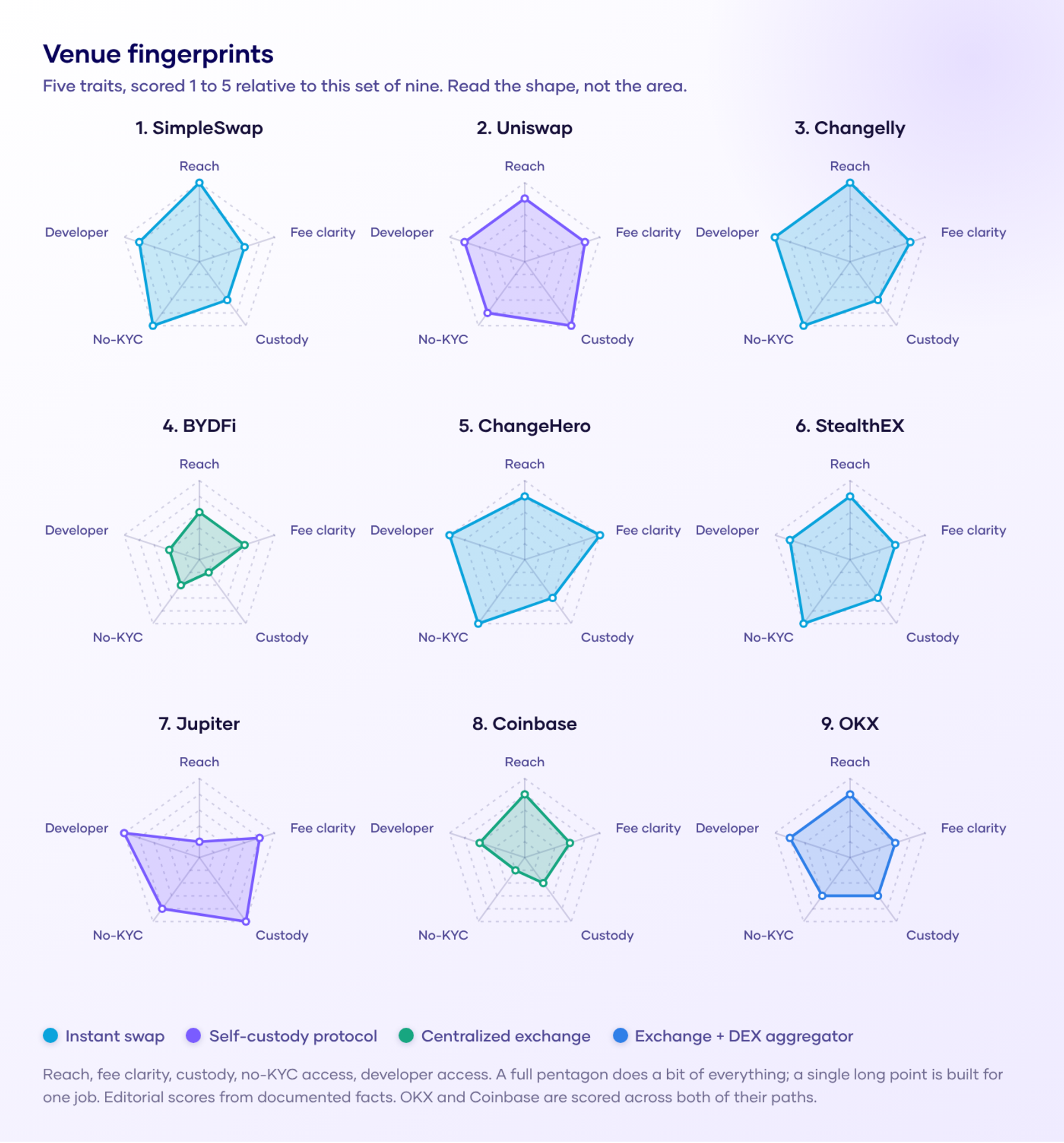
Scores are relative to this set of nine, not absolute grades. The widest reach in the set (thousands of assets, 100 or more chains) anchors the top of the reach axis and a single chain anchors the bottom. Fee clarity rewards a rate you can compute before sending and penalizes an undisclosed spread. Custody runs from never leaving your wallet, through a short wallet-to-wallet transit, down to a venue ledger. No-KYC rewards starting a swap with nothing more than an address, then a wallet connection, and scores upfront identity checks lowest; risk-based checks can still apply anywhere. Developer access rewards a free API with a widget, plugin, or MCP server over a keyed account. OKX and Coinbase each run a custodial book and a self-custody DEX path and are scored across both.
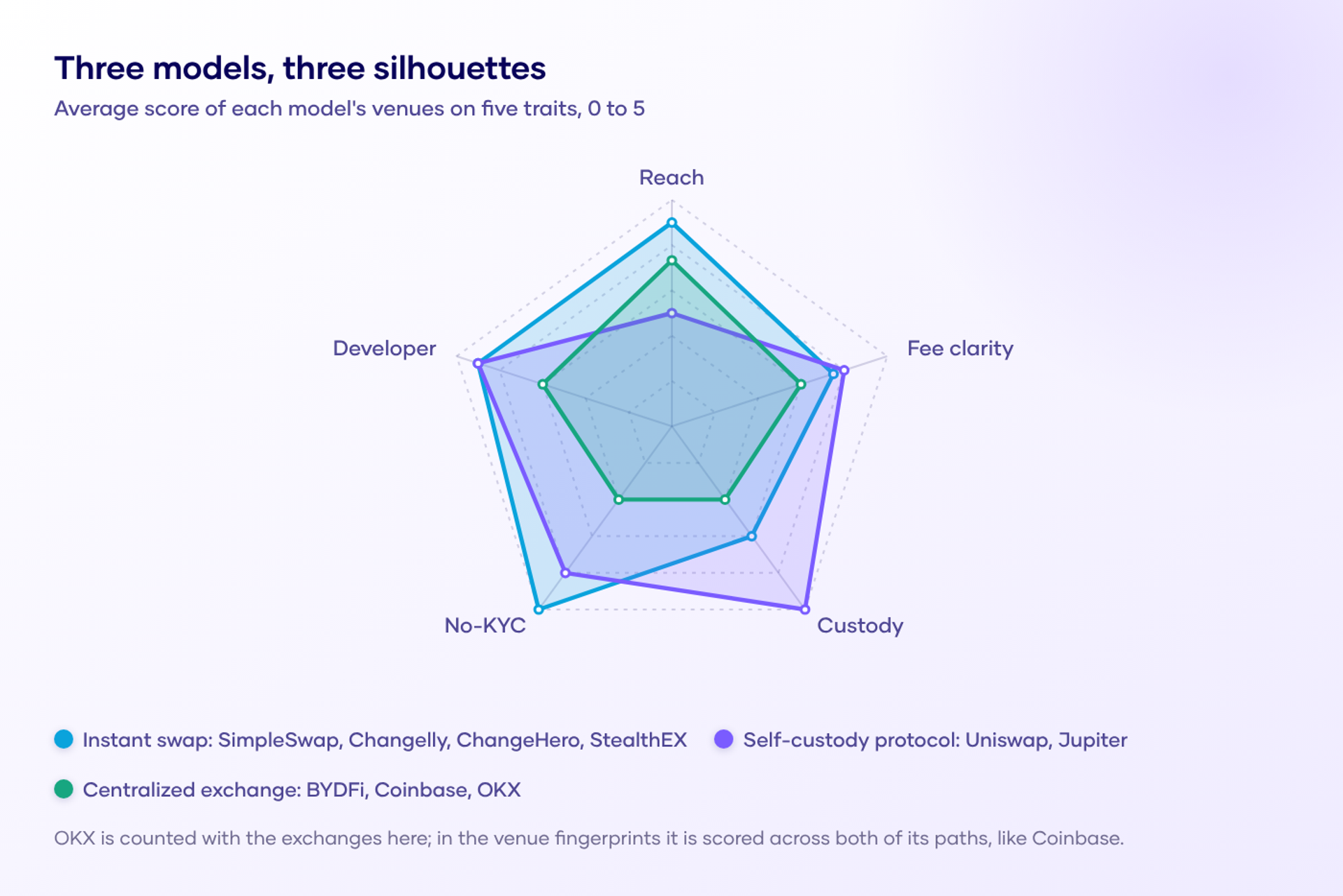
Averaged by model, the instant swap services, the self-custody protocols, and the centralized exchanges produce three recognizable silhouettes. The rest of the guide explains why.
Three models, three silhouettes
Why nine venues quote nine prices for the same pair
Three pricing mechanisms show up across the nine venues, often in combination, and they explain most of the differences in this guide.
The curve. An automated market maker holds two assets in a pool and prices each trade by how far it moves the ratio between them. Price impact grows with size. Uniswap pools and most of what Jupiter routes through work this way.
The book. A centralized exchange matches resting bids and asks. The spread is visible, depth is visible, and the exchange sets a maker and taker fee on top. BYDFi, Coinbase, and OKX offer order-book trading alongside simpler conversion or quote-based interfaces, where costs may be reflected in the quoted rate.
The route. Aggregators and instant swap services build their quote from other venues’ prices. They look for a favorable executable route among the sources they support, apply their own fee, and deliver the result. SimpleSwap, Changelly, ChangeHero, StealthEX, OKX DEX, and Jupiter’s router all work this way.
Each mechanism puts the cost somewhere different, and they stack. Curves put it in price impact. Books put it in the spread, plus size-dependent impact on a thin book. Routes put it in the provider’s fee or markup, on top of whatever the chosen source charges. The fee page rarely mentions any of the three.
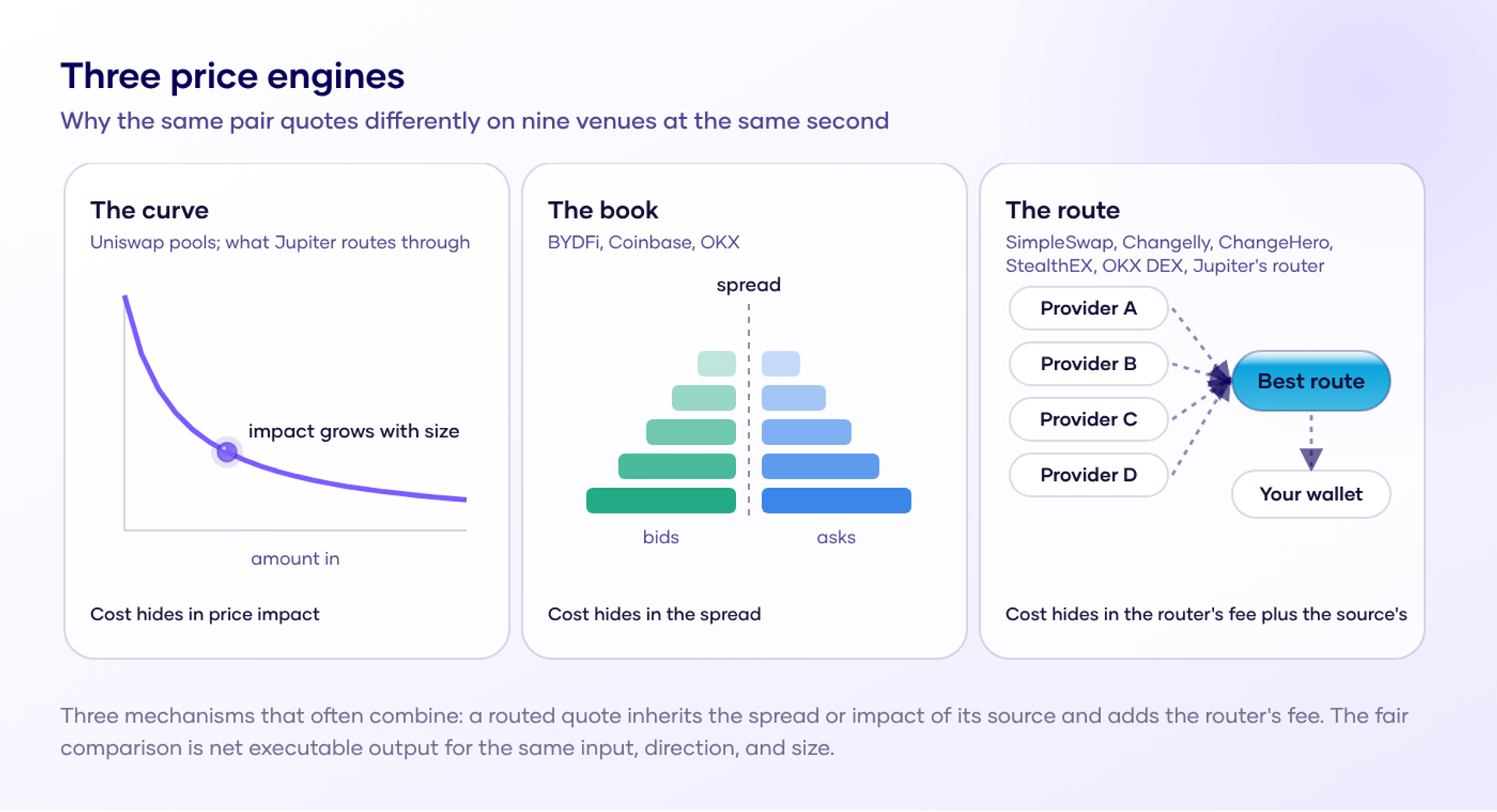
Three price engines
What makes a good crypto swap exchange in 2026?
Six things separate the nine venues.
Price formation and depth
A quote for $500 and a quote for $500,000 are different products, and only the second one tests depth. Depth is not one number. It is the resting liquidity on every venue where the pair trades, which is why exchange-level market data tells you more than a single reference price. Onchain execution can also face MEV, sandwich attacks included: per ethereum.org, value extracted by including, excluding, or reordering transactions in a block. Across both centralized and decentralized venues, latency and price movement between quote and settlement can change the final result, and latency varies by exchange and region, as CoinAPI’s latency route map shows.
Custody between send and receive
Three custody paths exist. An instant swap service receives the asset at a deposit address, routes it, and pays out to the wallet the user names. A self-custody protocol never holds a balance; the user signs, the contract settles, and the output lands in the same wallet. A centralized exchange takes the deposit into its ledger, and withdrawal is a separate step. Pricing and custody are separate dimensions, and two brands run more than one path. OKX pairs a custodial exchange with a self-custody DEX aggregator inside OKX Wallet. Coinbase pairs its custodial exchange with an in-app DEX that signs from a self-custody wallet whose key stays on the user’s device. The question to ask of any swap is whether it uses a user-controlled wallet, a provider deposit address, or an exchange balance.
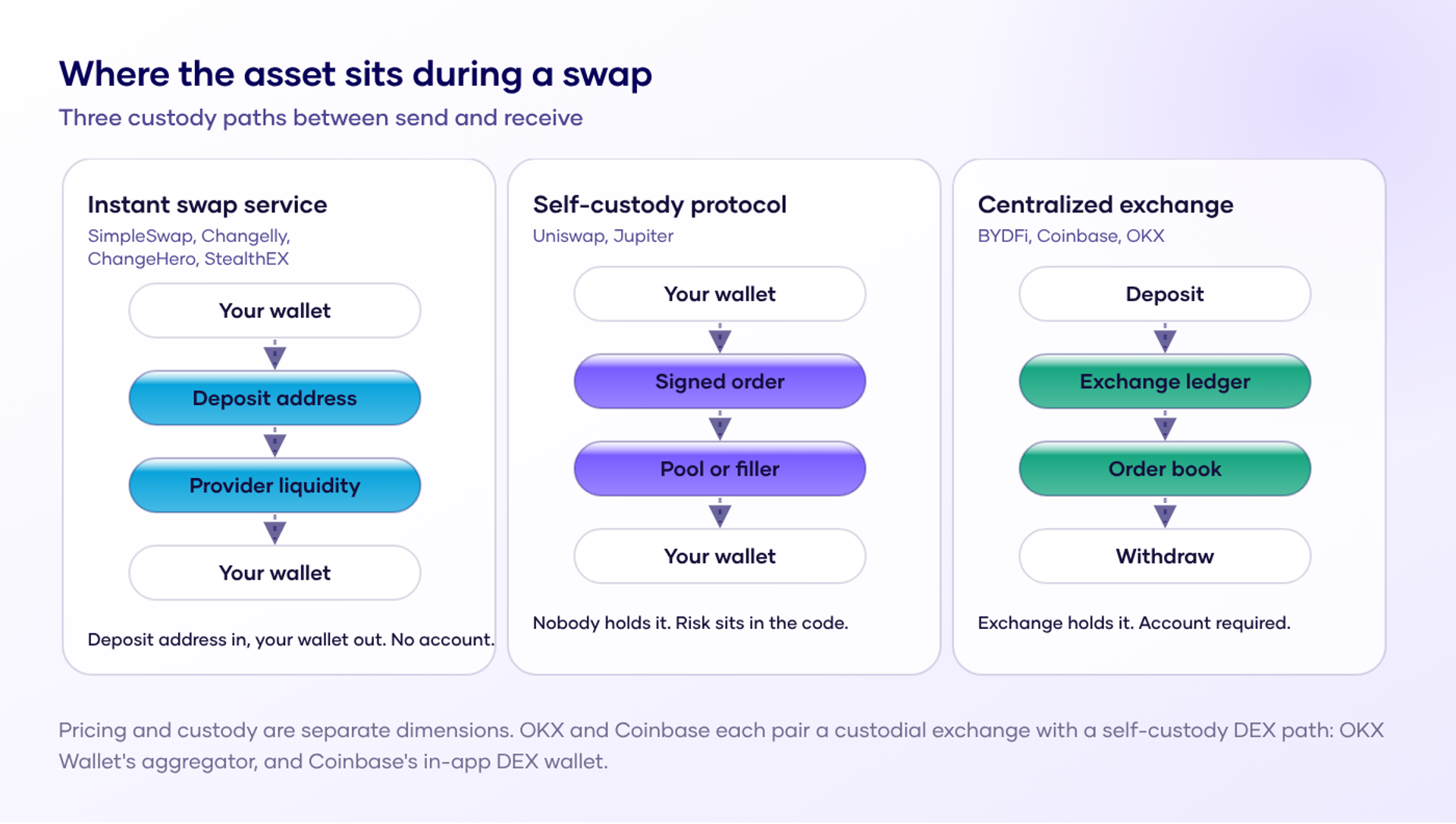
Where the asset sits during a swap
What the fee page says
Think of a quote as a stack. The mid-price sits at the bottom. On top of it come the protocol’s take, the liquidity provider’s take, the interface’s take, the network fee, the spread or price impact, and whatever an integration partner adds. A fee page usually names one layer of the stack. A venue that discloses one layer is not necessarily cheaper than one that discloses none. The quoted receive amount is the best single number, but it is not always the whole cost: gas paid separately, approval transactions, bridge fees, and deposit or withdrawal charges can sit outside it, and the final executed output can differ from the quote. The useful comparison is the net amount received for the same input, direction, and size, accounting for separately charged gas, approval transactions, bridge charges, and withdrawal fees where applicable. Final execution can differ from the original quote.
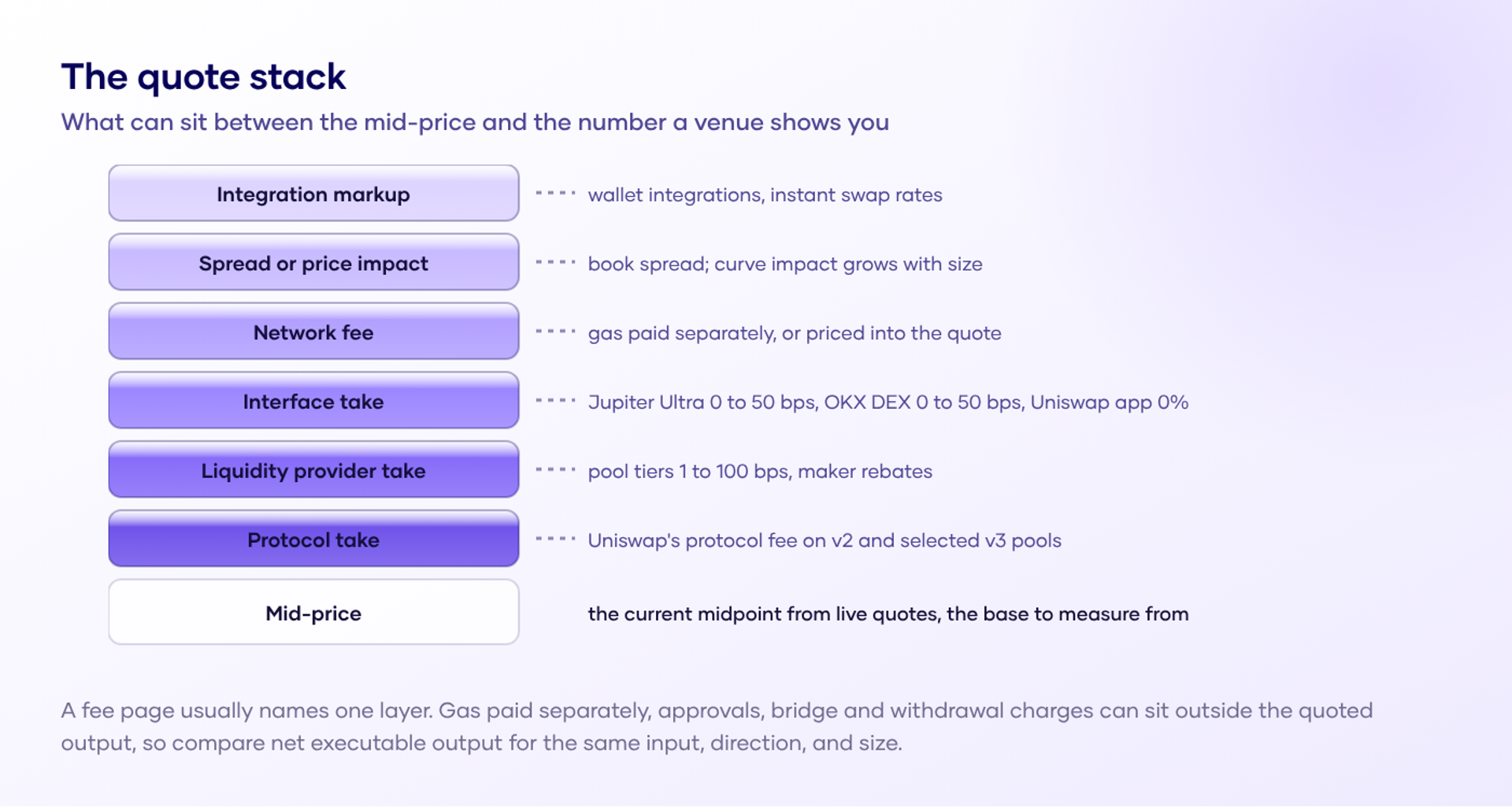
The quote stack
Verification and access
MiCA’s maximum transitional period ended on July 1, 2026, the date given on ESMA’s MiCA page; some national windows closed earlier. Providers within its scope need the required authorization or another permitted legal basis to serve EU clients. The centralized exchanges in this guide verify identity before fiat trades, and Coinbase and OKX’s exchange before any trade. Instant swap services and onchain protocols do not require an account to start a swap, and most crypto-to-crypto swaps on them complete without identity verification. The instant swap services nonetheless run risk screening that can hold a flagged transfer for verification, and SimpleSwap, Changelly, and ChangeHero each restrict certain locations in their terms: the United States in all three cases, and most or all of the EU in two. Account and verification requirements depend on the provider, the service, and the user’s jurisdiction.
Chain and asset coverage
The range runs from one chain (Jupiter) to 200 chains (Changelly), and StealthEX’s asset list runs past 2,000 cryptocurrencies. Native Bitcoin is out of reach on Uniswap and Jupiter. Two venues publish several network counts, each for a different product, so the count that matters is the one for the product being integrated.
Developer surface
What a developer gets beyond a quote endpoint: a key with or without a price on it, streaming data, a drop-in widget, an MCP server for agents.
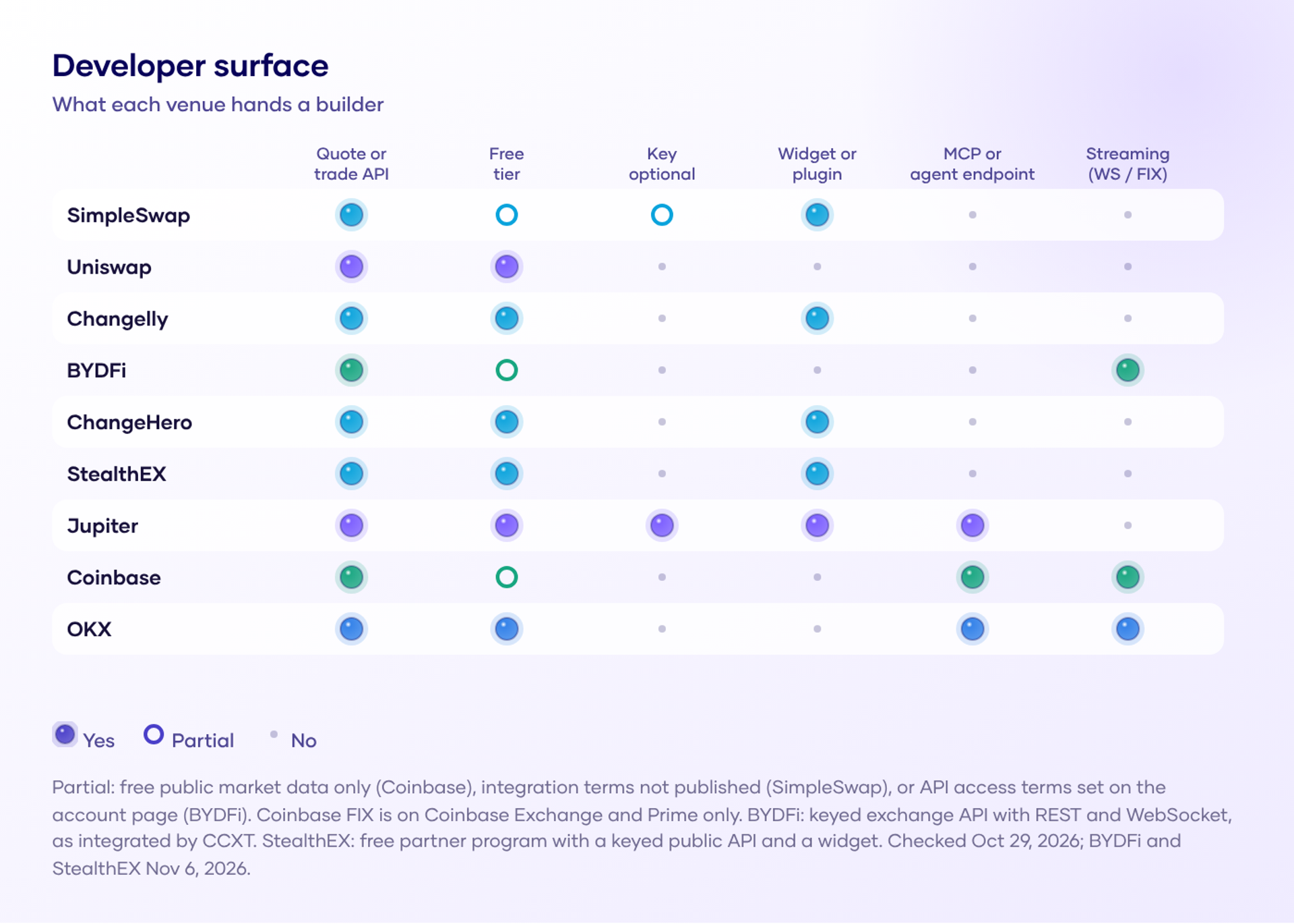
Developer surface by venue
Crypto swap exchange comparison table (2026)
| Venue | Price Engine | Custody | ID check | Published Fee | Reported 30-day Volume | Developer Surface |
| SimpleSwap | Route, 20+ CEX and DEX providers | Wallet to wallet via deposit address | Not by default | Dynamic, inside the rate, from 0.2% for some assets | Not published | APIs, widgets, and custom integrations through a technology partnership with SimpleRoute |
| Uniswap | Curve (v2, v3, v4) plus UniswapX intents | Self-custody | No | 0% Labs interface fee; v2 0.30%; v3 tiered 0.01% to 1%; v4 pool-specific, with potential protocol and hook fees | $64.1B DEX volume | Trading API, free key |
| Changelly | Route, instant swap | Deposit address, payout to wallet | Not by default | 0.25% floating, dynamic fixed, inside the rate | Not published | Partner API, widget |
| BYDFi | Book, plus Convert on a quote model | Custodial; withdrawal is a separate step | Yes for fiat and most rewards | 0.1% / 0.1% spot base at VIP 0; Convert no separate fee, costs in the rate | Not in CoinStats’ rankings; about $681.6M rolling 24-hour spot on CoinMarketCap | Keyed exchange API, REST and WebSocket (CCXT integration); futures data on TradingView |
| ChangeHero | Route, ten-plus providers | Deposit address, payout to wallet | Not by default | 0.5% Best Rate, up to 0.7% fixed | Not published | API v3, widget |
| StealthEX | Route across exchange liquidity (Binance, KuCoin, Mexc and others) | Wallet to wallet via a generated address | Not by default; risk screening can hold a swap | Embedded in the rate, around 0.4% for popular pairs before spread | Not published | Public API, drop-in widget, partner revenue share |
| Jupiter | Route across Solana AMMs plus RFQ fills | Self-custody | No | Platform fee 0% to 0.5% by pair, 0.5% on tokens under 24 hours old; gas extra | $13.4B aggregator volume | Swap API V2, Plugin, MCP |
| Coinbase | Book, plus in-app DEX on Base and Solana | Custodial exchange; self-custody in-app DEX wallet | Yes | 0.50% / 0.90% Advanced entry (US), spread on Simple | $120B spot | Advanced Trade API, Agents MCP |
| OKX | Book (exchange) and route (OKX DEX) | Custodial exchange, self-custody DEX | Exchange yes, DEX no | 0.08% / 0.10% spot (global), generally 0% to 0.5% DEX interface fee; selected tokenized-stock swaps have a 0.01% exception | $84B spot, $5.2B DEX | OKX OS DEX API, exchange REST and WebSocket |
The volume column reports past turnover, which is not executable depth for any particular pair or size, and it mixes three measurements on purpose, because no single one covers all nine. DEX volume is DefiLlama’s trailing 30 days for Uniswap. Aggregator volume comes from DefiLlama’s aggregators page for Jupiter and OKX DEX, and part of it is routed through the same pools counted in DEX volume. Spot volume is the 30-day figure in CoinStats’ exchange rankings, from the Coinbase row rather than the separately listed Coinbase Exchange row. The four instant swap services publish no volume at all. Treat the column as context, not as a league table and not as depth. Symbol naming also differs by venue, one of the reasons crypto data breaks when figures from several sources are stacked without normalization. BYDFi does not appear in CoinStats’ rankings, so its row carries CoinMarketCap’s rolling 24-hour spot figure, $681.6M at 11:40 (UTC+8) on November 5, 2026, which is not directly comparable to the onchain volumes. DefiLlama and CoinStats figures were retrieved on November 4, 2026 at 07:49 UTC and 07:45 UTC; they move daily.
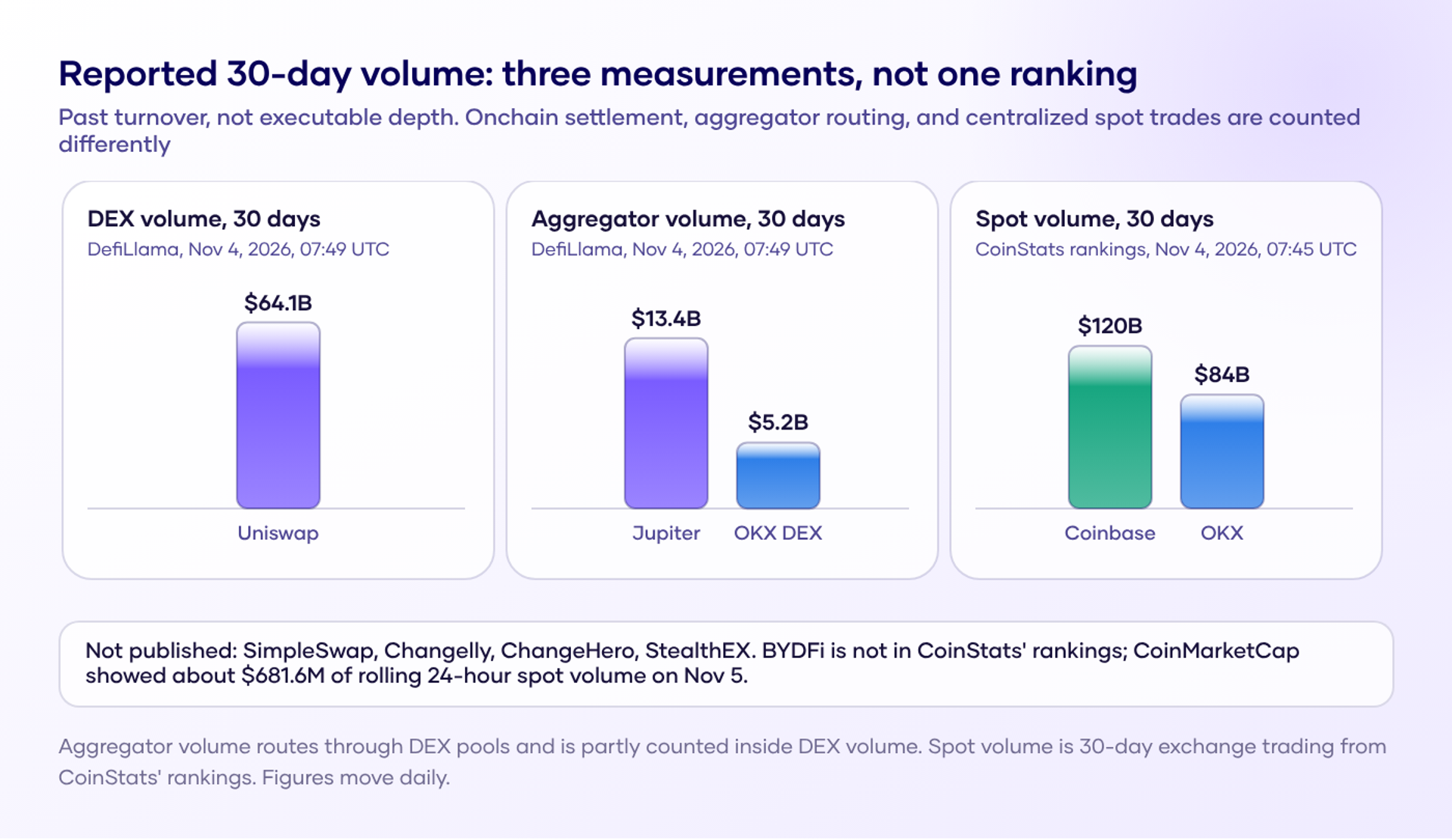
Reported 30-day volume: three measurements, not one ranking
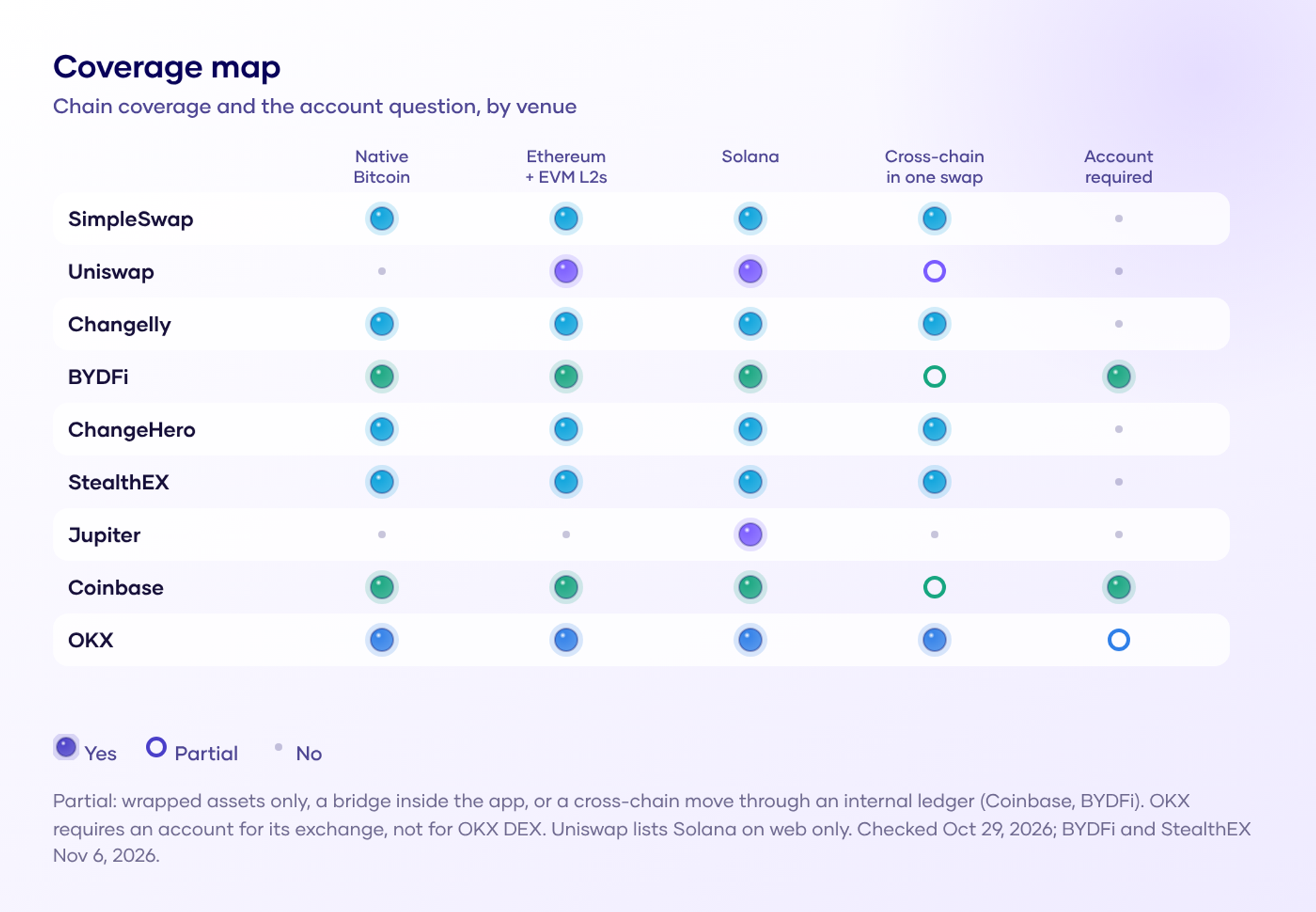
Coverage map
The 9 best crypto swap exchanges in 2026
1. SimpleSwap
Best for: users who want broad asset coverage and wallet-to-wallet cross-chain swaps without manually comparing providers or opening an exchange account.
SimpleSwap is a wallet-to-wallet multi-source swap aggregator that does not require users to maintain an exchange balance or compare providers and routes themselves. Users send assets to a designated deposit address and receive the exchanged assets in their chosen wallet. It supports direct wallet-to-wallet swaps across 20+ liquidity providers and 2,800+ swappable assets, combining liquidity from well-known CEX and DEX sources under the hood. Assets span 100+ blockchain networks, from Bitcoin and stablecoins to privacy-focused assets such as Monero (XMR) and Zcash (ZEC), subject to pair and network availability. SimpleSwap reports 8+ years on the market and 10M+ users over time. SimpleSwap’s only official domain is simpleswap.io.
Price engine: SimpleSwap pulls liquidity from multiple sources and handles provider and route selection under the hood, so users don’t have to compare options or build the swap manually. Users select a pair, enter a receiving address, and send their deposit. SimpleSwap handles the routing and delivers the exchanged assets to the specified wallet. SimpleSwap says combined liquidity helps it handle larger swaps more effectively and can reduce price impact for some assets, including swaps worth hundreds of thousands of dollars; available liquidity and quoted output still depend on the pair and size. Flexible routing and provider management help add new assets faster and adjust swap conditions more efficiently.
Costs and checks: Both fixed and floating rates are available. The service fee is included in the exchange rate and varies by pair and market conditions, starting from 0.2% for some assets, so users should compare the quoted receiving amount rather than assume a flat percentage. Minimum amounts are shown when creating a swap. Floating-rate swaps have no strict upper limit, subject to liquidity, network conditions, and internal checks. The loyalty program gives registered users a tier-based service fee discount of up to 20%; Gold and Platinum users can choose USDT cashback instead, up to 0.4% at Platinum. No account registration is required, and most crypto-to-crypto swaps are completed without identity verification. Swap times depend on blockchain congestion, confirmation requirements, and available liquidity, and additional verification may extend processing times. Jurisdictional restrictions apply: the Terms of Service list the United States, the United Kingdom, and every EU member state among restricted locations, so check the current list before use.
Developer surface: Wallet-to-wallet by design: SimpleSwap does not use on-platform user balances. SimpleSwap reports that 6,000+ projects use it as a business solution, including Exodus and Tangem. Integrations also include ELLIPAL, Cake Wallet, and NEAR Intents. SimpleSwap’s swap and aggregation capabilities are also available to wallets and other crypto products through its technology partnership with SimpleRoute, which offers APIs, widgets, and custom integration options.
Where SimpleSwap fits: The widest published asset and network coverage among the account-free venues here, with route selection done for you and payout to a wallet you control. Judge it by the quoted receiving amount, since the fee moves with the pair.
2. Uniswap
Best for: the deepest onchain liquidity in one place, and builders who want a routing API with no per-call charges.
Uniswap launched in November 2018 and is still the reference automated market maker. DefiLlama shows $64.1B settled through its pools in the trailing 30 days, more than any other DEX. The interface lists 22 networks on its networks page, including Solana on the web app. The Trading API and the protocol’s deployments keep their own network lists, so confirm support for the product being integrated.
Price engine: Two engines run under one interface. The pools (v2, v3, and v4) price against liquidity curves, with v3 and v4 concentrating liquidity in ranges. UniswapX fills orders through Dutch auctions where third-party fillers compete, with 11 chains in the API’s supported-chains table. In 2026 the protocol went live on X Layer in January, Robinhood Chain in July, and Arc in September. In the 30 days to October 29, 2026, v4 handled about 59% of Uniswap’s Ethereum volume on DefiLlama.
Costs and checks: Pool fees are published: 0.30% on v2; 0.01%, 0.05%, 0.30%, or 1% on v3; and a pool-specific rate on v4, anywhere from 0% to 100%, static or dynamic through hooks. The protocol’s share on v2 and v3 comes out of that swap fee rather than on top of it. In v4, LP fees, protocol fees, and hook-specific fees can apply depending on pool configuration; v4 protocol fees became active in 2026. Two changes landed within a week last December. On December 25, 2025, the UNIfication proposal passed with 99.9% support, switching on the protocol fee for v2 and a selection of v3 pools, and 100M UNI were burned on December 28. On December 27, Uniswap Labs stopped charging its 0.25% interface fee, in place since April 2024. No account, no ID; the interface screens wallet addresses. Native Bitcoin is out of reach; wrapped versions only.
Developer surface: The Uniswap Developer Platform went live on April 16, 2026. Keys come from a dashboard and there are no subscription fees or per-call charges. Uniswap’s announcement cites routing in about 200ms across a 10M+ asset catalog, with LP endpoints alongside the swap routes.
Where Uniswap fits: Same-chain EVM swaps where depth matters most. Check the network list for the specific product you integrate, since the app, the API, and the protocol deployments are listed separately, and watch protocol and pool-specific fees, which vary by version and pool.
3. Changelly
Best for: a 1,200+ asset list and fiat rails in the same place as the swaps.
Changelly is the oldest instant swap service here, running since 2015. It reports 12 million registered users, 840+ integration partners, and a list that runs past 1,200 cryptocurrencies across 200 blockchains, the widest chain count in this guide.
Price engine: Swaps execute without registration, and the output routes straight to the wallet address the user supplies. Fixed and floating rates are both offered; Changelly’s early fixed-rate work with Exodus set the pattern the rest of the category followed. Alongside the swap engine, DeFi Swap routes across 100+ DEXs to reach onchain liquidity that the centralized path misses.
Costs and checks: Floating swaps carry a published 0.25% service fee, built into the rate. Fixed-rate swaps carry a dynamic fee to cover volatility. Verification stays risk-triggered on crypto-to-crypto swaps, so a flagged transaction can still be held. Changelly’s distinguishing piece is a built-in fiat marketplace. Its Buy marketplace advertises offers from 15+ fiat providers across 100+ fiat currencies, and selling is available too; coverage and verification depend on the provider selected, which runs its own checks. Availability has limits: Changelly’s terms exclude the United States, the United Kingdom, Germany, Austria, and Japan, among other locations.
Developer surface: A partner API and a widget power the 840+ integrations. A mobile app ships in 12 languages and averages a self-reported 4.7 stars across the App Store and Google Play.
Where Changelly fits: The widest chain count and fiat in and out from the same place, where it is available. Watch for verification triggers on crypto-to-crypto swaps the risk engine flags.
4. BYDFi
Best for: users who want account-based spot trading with room to explore crypto futures, TradFi and automated strategies.
BYDFi is a centralized exchange that combines spot crypto trading with futures, TradFi markets and automated strategies. It launched in 2020 and serves 1,000,000+ users in 190+ countries and regions. At 11:40 (UTC+8) on November 5, 2026, CoinMarketCap displayed approximately $681.6M in rolling 24-hour spot volume.
Price engine: The order book prices spot trades, and Convert runs on a quote model beside it, with no order-book matching and no slippage. BYDFi also offers USDT-M, USDC-M and COIN-M perpetual futures, and its TradFi range extends that futures-based approach to US stocks, gold, silver and crude oil through USDT-margined perpetual contracts. Copy Trading and the Spot DCA, Spot Grid and Futures Grid bots run from the same account; the bots have no separate creation or management fee.
Costs and checks: The order book charges a base 0.1% maker and 0.1% taker fee at VIP 0, per the fees page, and VIP 1 to 7 lower the rates from 100,000 USDT of 30-day spot volume, 10,000,000 USDT of futures volume or 50,000 USDT in holdings. Convert charges no separate fee, with costs built into the quoted rate. There is no BYDFi fee on crypto deposits; moving assets to an external wallet requires a separate withdrawal, with its own fee. Fiat comes in through One-Click Buy or zero-fee bank transfers via Legend Trading in six currencies. Identity verification is required for fiat purchases and sales and for most rewards. BYDFi holds Money Services Business registrations in multiple countries and has been a member of South Korea’s CODE VASP Alliance since 2024.
Developer surface: An exchange API keyed from the account’s API management section. The open-source CCXT library carries a BYDFi integration with REST methods and WebSocket streams for spot and futures. Its perpetual futures market data has been on TradingView since March 2026.
Where BYDFi fits: Account-based spot trading at 0.1% / 0.1%, alongside three perpetual futures settlement families and TradFi markets. Tradeoffs: a separate withdrawal on the way out, and Spot DCA at up to 10 cryptocurrencies per plan. Cryptocurrency trading involves significant risk; leveraged products such as perpetual futures can magnify both gains and losses, and BYDFi’s products are not available in all jurisdictions.
5. ChangeHero
Best for: users who want a predictable swap with a fee they can calculate in advance. Also anyone who will not connect a wallet to a website.
ChangeHero has run since 2017 and has one of the simplest flows in this guide. No wallet connection, no account: enter a pair and an amount, provide a receiving address, send. It reports more than three million users. Coverage runs past 400 cryptocurrencies, with listings weighted toward Solana-ecosystem tokens, DeFi assets, and BRC-20s.
Price engine: A liquidity aggregator that scans ten-plus integrated providers in real time and delivers the swapped asset directly to the address supplied. Best Rate floats with the market. Fixed Rate locks the quote for fifteen minutes.
Costs and checks: The fee is a flat 0.5% of the swap value on Best Rate, a figure that comes from ChangeHero’s published schedule. Fixed Rate runs up to 0.7%, and a Best Rate quote can move until the deposit arrives. Verification is risk-triggered rather than upfront, and the AML policy lets ChangeHero request documents or hold a transfer. Its terms exclude the United States, Japan, Ontario, and the European Union, among other locations. Two things to know before relying on it: the rates live in a homepage FAQ rather than a proper fee page, and published asset counts run 300+, 350+, and 400+ across its own pages, so no single figure is authoritative.
Developer surface: API v3 powers in-wallet swaps for Exodus, Trezor, Tangem, and CoolWallet. A drop-in widget serves teams that do not want to build a swap UI.
Where ChangeHero fits: A fee you can compute before you send, aggregated rates that cover pairs single venues do not list, and no wallet connection. Not built for advanced traders: no charts, order books, or limit orders.
6. StealthEX
Best for: users looking for pairs and long-tail assets the larger platforms have not listed.
StealthEX launched in 2018 and has built its position on asset breadth rather than volume. Execution is guest-side: you send to a generated address and the output is routed to the address you supply, across multiple liquidity sources including Binance, KuCoin and Mexc. No account, no wallet connection.
Price engine: A route across exchange liquidity rather than a pool or a book. Asset coverage runs past 2,000 cryptocurrencies, noticeably deeper into the long tail than most instant swap competitors, which is why people end up there. Both fixed and floating rates are available, there is no upper limit on crypto-to-crypto swaps, and a swap typically completes in five to thirty minutes depending on confirmation requirements on either chain. Built for breadth, not depth: no order book, charts or limit orders.
Costs and checks: The fee is embedded in the quoted rate rather than charged separately, landing around 0.4% for popular pairs before spread, so the exact cost is visible only when you request a rate. Transactions flagged by automated risk screening are held for verification, and card-based fiat purchases are routed through Mercuryo and Guardarian.
Developer surface: For partners there is a public API and a drop-in widget, with an adjustable revenue share. The partner program is free and comes in several integration formats.
Where StealthEX fits: Past 2,000 assets, no registration, and no upper limit on crypto-to-crypto swaps, with liquidity routed across Binance, KuCoin, Mexc, HTX and others. Judge it by the quoted rate, since the fee is embedded in the quote rather than itemized.
7. Jupiter
Best for: anything on Solana, and agent builders who want an MCP endpoint.
Jupiter launched in October 2021 and runs on one chain only. DefiLlama ranks it first among DEX aggregators at $13.4B in the trailing 30 days. Its engine is also inside other venues: Coinbase routes its in-app Solana swaps through Jupiter, and Robinhood, Uniswap, and MetaMask announced integrations too, per Jupiter’s 2025 year in review, published in March 2026.
Price engine: In the app, Ultra mode routes across Solana’s AMMs and adds RFQ fills from market makers through JupiterZ, while Manual mode exposes the router with no Jupiter commission. In the API, the managed /order path has Metis, JupiterZ, DFlow, and OKX compete on every request and handles execution, while /build returns Metis instructions for custom execution with no Jupiter swap fee.
Costs and checks: Ultra charges 0% to 0.5%, varying by token pair and volatility. The developer schedule for the platform fee is more exact: 0 bps on pegged pairs, 2 bps on SOL to stablecoin, 5 bps on LST to stablecoin, 10 bps on other pairs, and 50 bps on tokens less than 24 hours old. When an integrator sets its own fee, Jupiter keeps 20% of it rather than adding a separate platform fee. Gas and other network costs sit on top; gasless mode adds the relayer’s SOL cost with no margin. No account, wallet signature only.
Developer surface: The most agent-ready stack in this guide. Swap API V2 consolidated Ultra and the Metis router in March 2026. A hosted MCP server at mcp.jup.ag exposes more than 70 tools, and an API key is optional. Keyless access runs at 0.5 requests per second and a free key raises it to 1. Paid plans at $25, $100, and $500 a month add rate capacity and usage credits, with overage billed.
Where Jupiter fits: Solana, where it is the default router, and any bot or agent that needs a quote endpoint it can call without a key. Watch the 50 bps tier on tokens under 24 hours old.
8. Coinbase
Best for: fiat in and out under a licensed counterparty, plus Base and Solana tokens without leaving the app.
Coinbase is the largest US-listed exchange, founded in 2012 and licensed under MiCA by Luxembourg’s CSSF since June 2025. Its crypto trading volume market share reached 10.3% in Q2 2026, an all-time high per the Q2 2026 earnings release. CoinStats’ rankings put its 30-day spot volume near $120B, and CoinGecko counts about 400 coins on Coinbase Exchange.
Price engine: Two paths in one app. The order book prices Simple and Advanced trades. The in-app DEX lets eligible users trade supported Base and Solana tokens through a self-custody wallet whose signing key stays on the user’s device, per Coinbase’s DEX guide; availability depends on region, liquidity, and screening. A Launches tab added in July 2026 surfaces new Base and Solana tokens as they go live. The Solana leg runs through Jupiter.
Costs and checks: Simple trades include a spread in the quoted price plus a fee that the fee page describes but does not quantify. Coinbase adds no quoted-price spread to Advanced trades; the order book’s own bid-ask spread, price impact, and a maker and taker schedule still apply. Coinbase cut Advanced fees on September 16, 2026, per its announcement: tiers now start at $10,000 in qualifying volume, with entry rates of 0.50% maker and 0.90% taker in the US and 0.25% and 0.50% in the EU and UK. DEX trades carry a separate service fee that Coinbase One does not cover. Identity verification comes before any trade.
Developer surface: The Advanced Trade API over REST and WebSocket, and Coinbase for Agents: a remote MCP server at agents.coinbase.com with OAuth and x402 payments. Advanced Trade uses REST and WebSocket; Coinbase’s separate institutional and derivatives products offer FIX.
Where Coinbase fits: A licensed on-ramp with a self-custody DEX path built in. Watch the Simple trade spread, which the fee page does not size, and the extra service fee on DEX trades.
9. OKX
Best for: one account for a KYC’d order book and a self-custody aggregator.
OKX runs two ledgers under one brand. The exchange, founded in 2017, holds a MiCA CASP authorization from Malta’s MFSA since January 2025 and relaunched in the US in April 2025, with availability varying by state. CoinStats puts its 30-day spot volume near $84B. OKX DEX, inside OKX Wallet, is a self-custody aggregator that DefiLlama ranks fifth at $5.2B in 30 days.
Price engine: The exchange prices off its book. The DEX swap interface advertises 400+ DEXs across 30+ networks, and the broader OnchainOS platform advertises 60+ networks and 500+ DEXs; confirm support for the specific endpoint and route. Cross-chain routes are part of the DEX product.
Costs and checks: Spot runs 0.08% maker and 0.10% taker for regular users on the global exchange, per the global fee page; OKX US starts higher, at 0.20% and 0.35%. Convert is advertised as zero fees with no slippage, and the spread is not disclosed. OKX DEX charges an interface fee by token group: 0% on long-tail to long-tail, 0.1% within Group 1, 0.25% between Groups 1 and 2 or within Group 2, and 0.5% when a Group 1 or Group 2 token pairs with a long-tail one; pool, network, and bridge costs can be additional. Certain tokenized-stock swaps on X Layer have a separate 0.01% interface-fee exception. The exchange side requires ID; OKX US added Texas in September 2026 and remains unavailable in New York and several US territories. The DEX side needs only a wallet.
Developer surface: OKX OS, which includes the DEX API and is free to start, a DEX SDK, the exchange’s REST and WebSocket APIs, and an AI Skills layer with MCP support added in March 2026.
Where OKX fits: A licensed book and a keyless aggregator under one brand, with the DEX path usable without an exchange account. Watch which product a network count refers to, and the undisclosed Convert spread.
What changed in 2026, in the venues’ own words
Crypto swap exchanges aren't standing still. DEXs are expanding onto new chains, aggregators are powering trades inside major platforms, and centralized exchanges are bringing onchain swaps directly into their apps.
Three developments from 2026 show how quickly the market is changing.
Uniswap: A new chain, $20 billion in volume
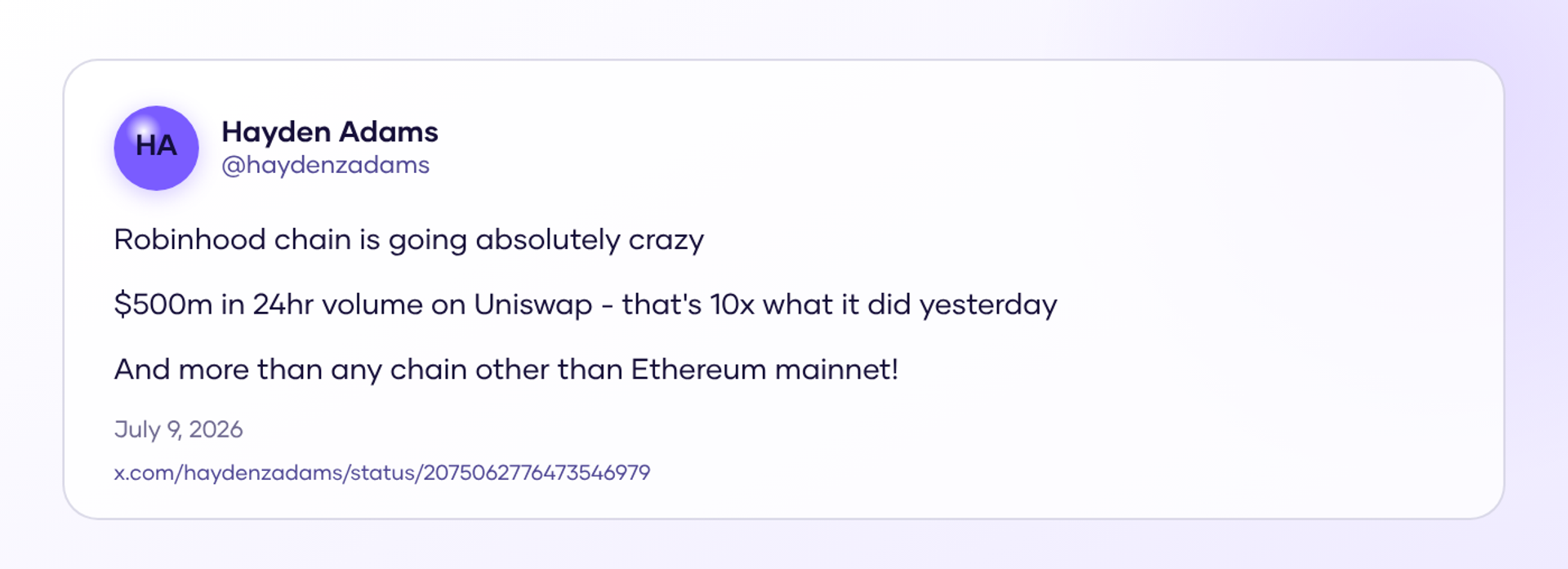
Post by Hayden Adams on X
When Robinhood Chain launched on July 1, Uniswap became its primary public automated market maker. By August 26, Uniswap reported more than $20 billion in protocol volume on the chain.
That's a significant shift for a new network. It also shows why chain coverage matters. As liquidity moves to new networks, developers need reliable access to the underlying data. CoinStats explores this challenge in its guide to Robinhood Chain APIs.
Jupiter: One routing engine, multiple platforms
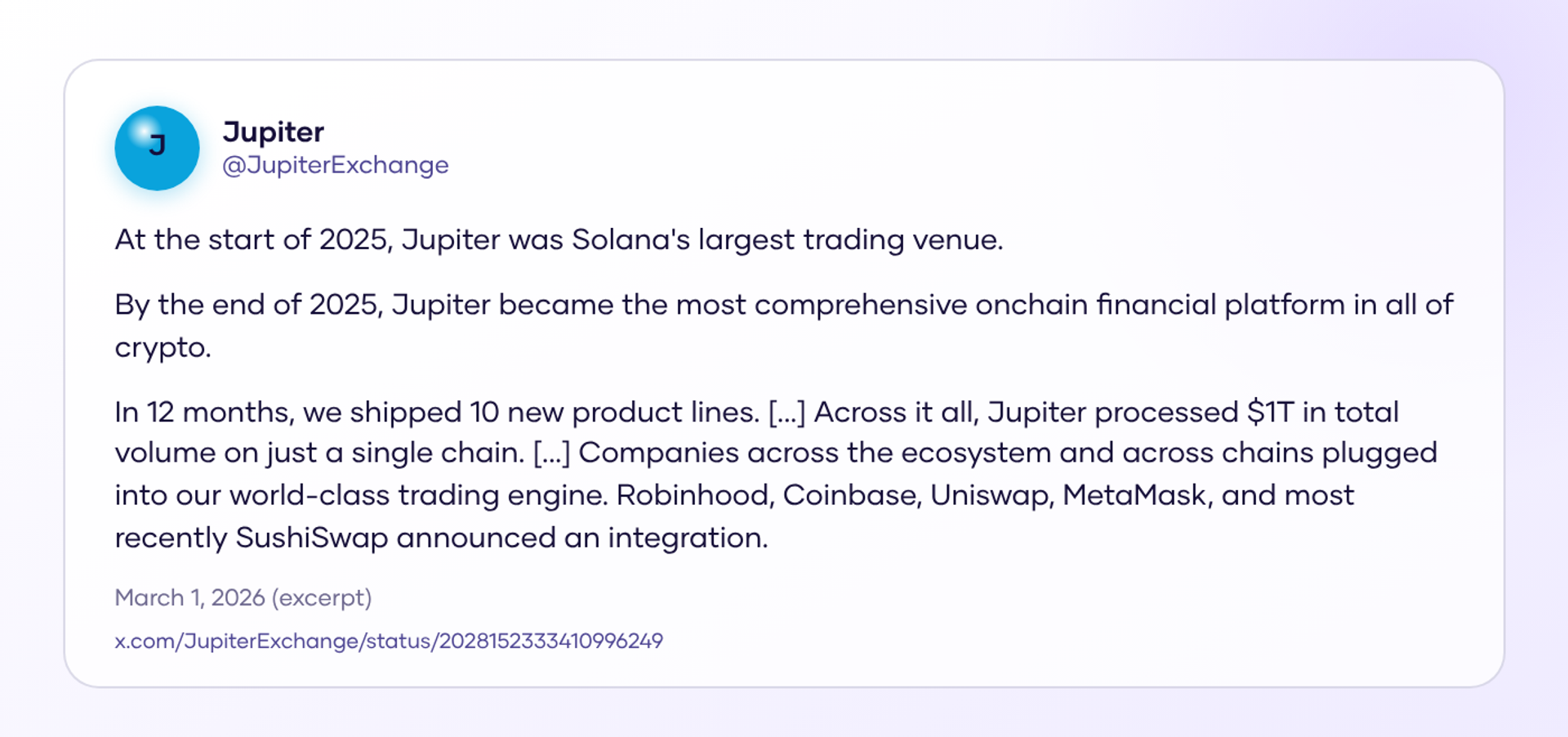
Post by Jupiter on X
Jupiter's influence now extends beyond its own interface. Coinbase, Robinhood, Uniswap, and MetaMask have announced integrations with its trading infrastructure.
That means a swap initiated on one platform may actually be routed through another. It's also why comparing volume across aggregators and exchanges isn't always straightforward: some of those trades pass through the same underlying liquidity.
Coinbase: Bringing DEX trading into a centralized exchange
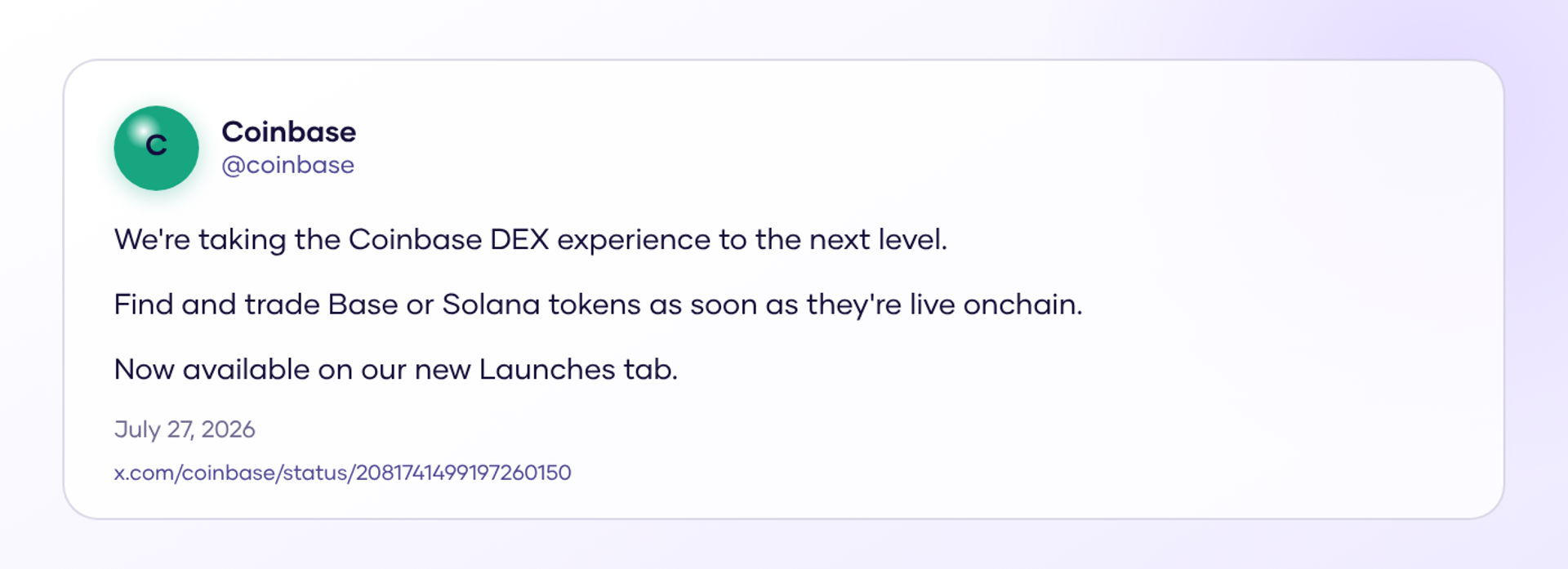
Post by Coinbase on X
In July 2026, Coinbase introduced its Launches tab, allowing eligible users to discover and trade supported Base and Solana tokens directly inside its app.
It's an interesting development. Instead of choosing between a centralized exchange and a DEX, users can increasingly access both through one interface.
The bigger picture: These developments point in the same direction. Order books, liquidity pools, and routing engines are becoming more connected, even when users interact with them through a single exchange app. That's why understanding how a swap is priced matters more than ever.
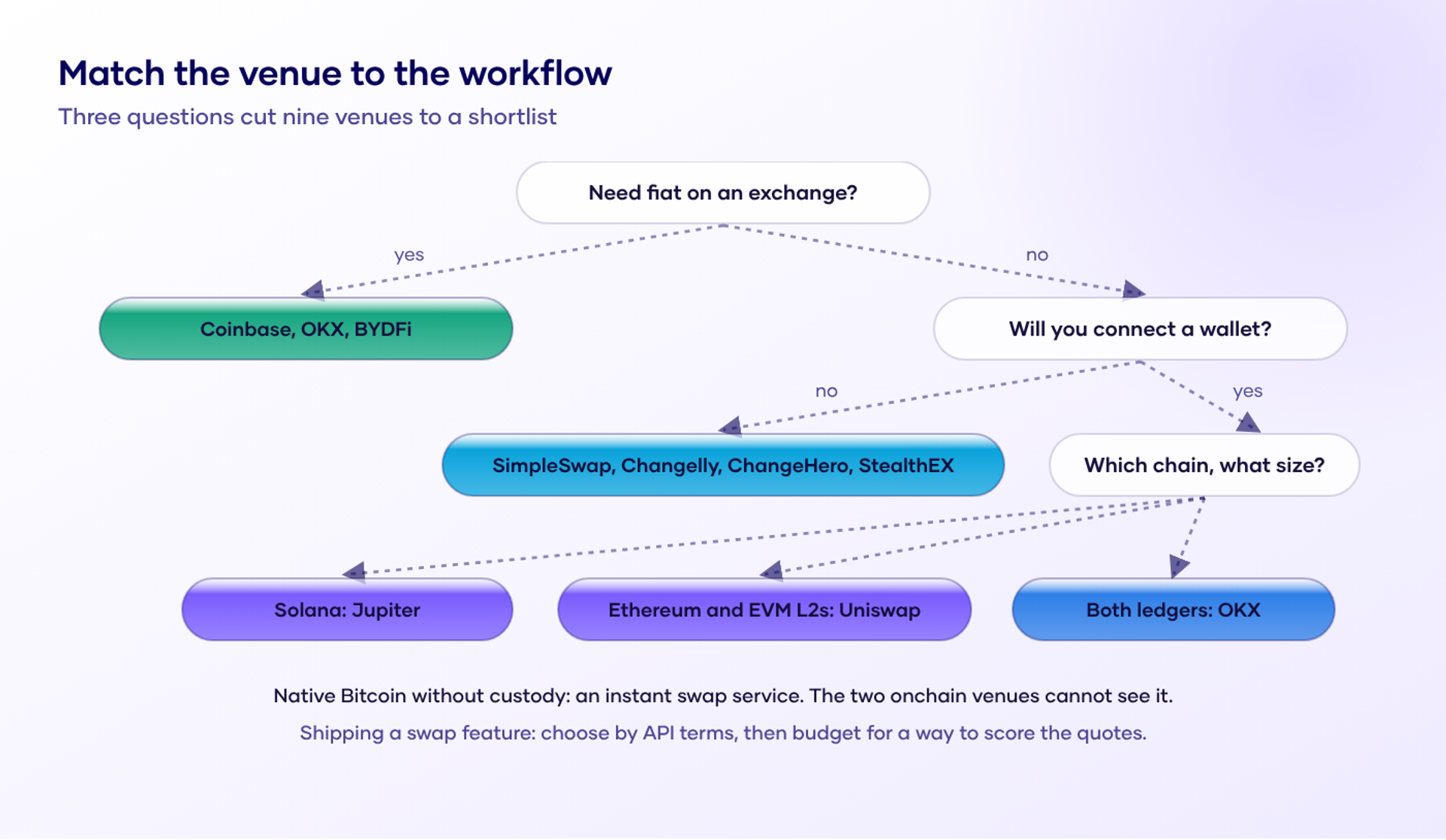
Which swap exchange fits which workflow
Moving between chains without an account
SimpleSwap for the broadest asset list backed by 20+ liquidity providers. Changelly when a fiat ramp is also needed. ChangeHero when the fee has to be known before sending. StealthEX when the pair or the long-tail asset is not listed elsewhere. All four see native Bitcoin; Uniswap and Jupiter cannot.
Buying with fiat on a centralized exchange
Coinbase in the US, the UK, or the EEA. OKX where it is licensed, with the DEX in the same app as a plus. BYDFi where it is available, for a 0.1% / 0.1% book, zero-fee bank deposits in six currencies, and futures on stocks, gold and oil in the same account.
Trading Solana
Jupiter. Nothing else on Solana routes as much, and Coinbase’s in-app Solana swaps already go through it.
Moving size on Ethereum
Uniswap, where $64.1B settled in the trailing 30 days and a trade can clear in one deep pool, or UniswapX when competing fillers can beat the pool price. Judge the result by executed output, not by the pool’s fee tier, and check it against the book estimate in the next section.
Running a bot or an agent
Jupiter’s keyless API and MCP server on Solana. Uniswap’s Trading API on EVM, with no per-call charges. Coinbase for Agents for a licensed book with MCP access.
Shipping a swap feature
Choose by API terms, then budget for the two things the swap API will not give you: a way to score its quotes, and an RPC node or indexer for simulation, mempool reads, and pool state. The first of those is the next section. For the second, this comparison of RPC node providers covers the free and paid tiers across the main chains.
Match the venue to the workflow
How to check a swap quote against the market
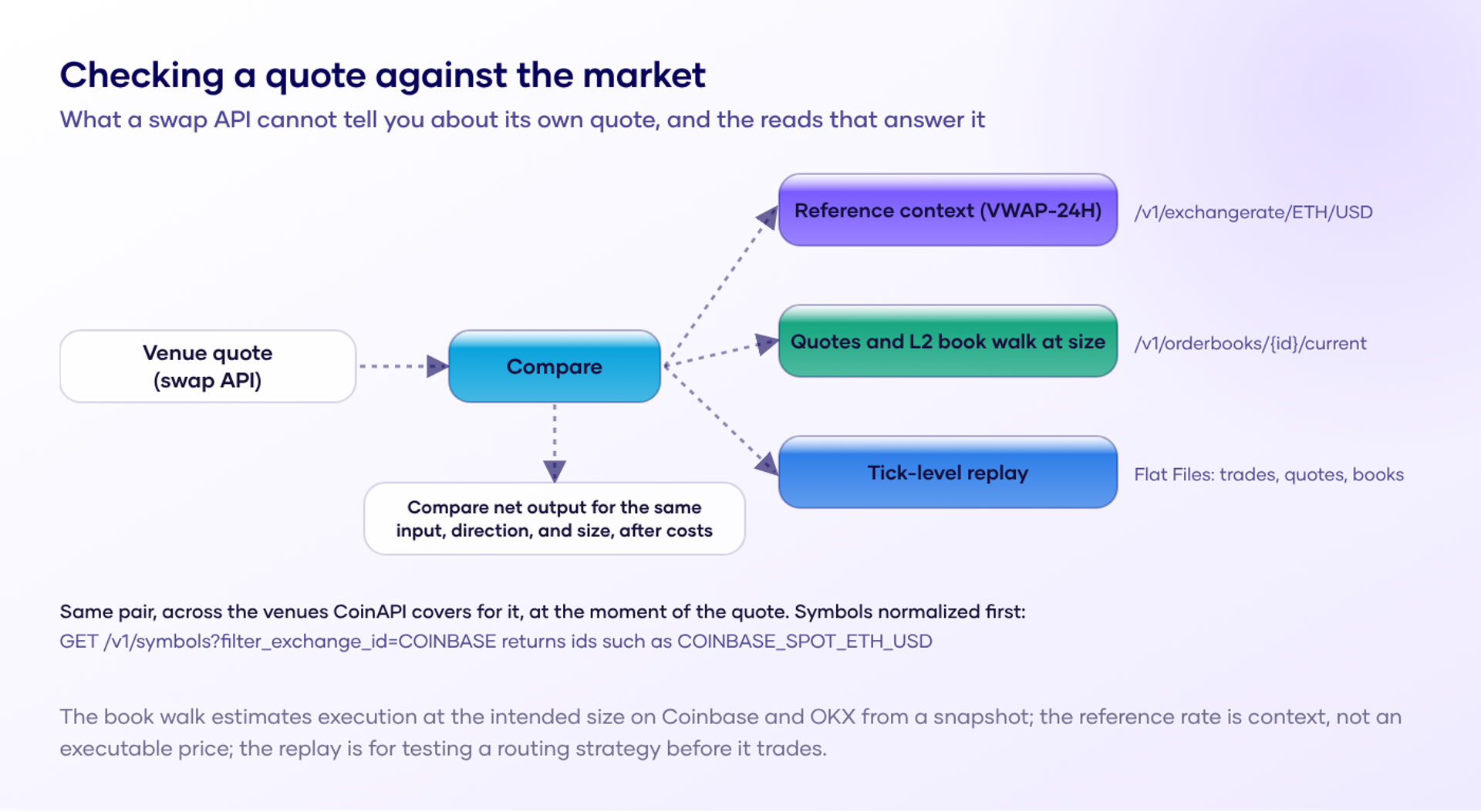
A swap API’s job ends at the quote. Whether that quote was competitive is a question it cannot answer about itself. Answering it takes the same pair, read across the venues CoinAPI covers for it, at the moment of the quote. A practical workflow has four stages.
Checking a quote against the market
- Resolve the symbols:
returns Coinbase’s instruments in CoinAPI’s normalized form, such as COINBASE_SPOT_ETH_USD. The same call works for OKX, which CoinAPI lists under OKEX. Requests go to rest.coinapi.io with an API key, and discovery across several venues takes several requests. Metadata normalization is what lets the next stages compare like with like.
- Pull the reference:
returns a VWAP-24H rate computed across multiple venues, the Exchange Rates API benchmark. It is a reference for valuation and benchmarking, not an executable bid and ask, so a quote that drifts from it is not proof of a markup. Use it as broader context, and judge execution quality against synchronized executable quotes and order-book estimates for the same assets, direction, and size, after costs.
- Pull the depth:
CoinAPI provides current order-book endpoints, including:
and the level-limited:
confirm the endpoint and depth format supported by your plan and dataset before integrating. Walking the correct side of the book for the intended size gives an estimate of execution price and price impact from the visible snapshot on Coinbase or OKX, with trading fees added and exchange and receipt timestamps checked.
The book can move before execution, and a snapshot that runs out of depth is not unlimited liquidity. That estimate is the number to put next to a live route quote from Uniswap or an aggregator, matched on the same asset contracts, chains, and quote currency. The CoinAPI Market Data API streams the same books over WebSocket for continuous scoring, and its DEX coverage adds historical Uniswap v2 and v3 swaps for context, though a current AMM quote still needs live pool state or a route quote.
- Replay it:
CoinAPI Flat Files hold tick-level trades, quotes, and full books, which is what a backtest of a routing strategy needs.
Published swap fees, in basis points
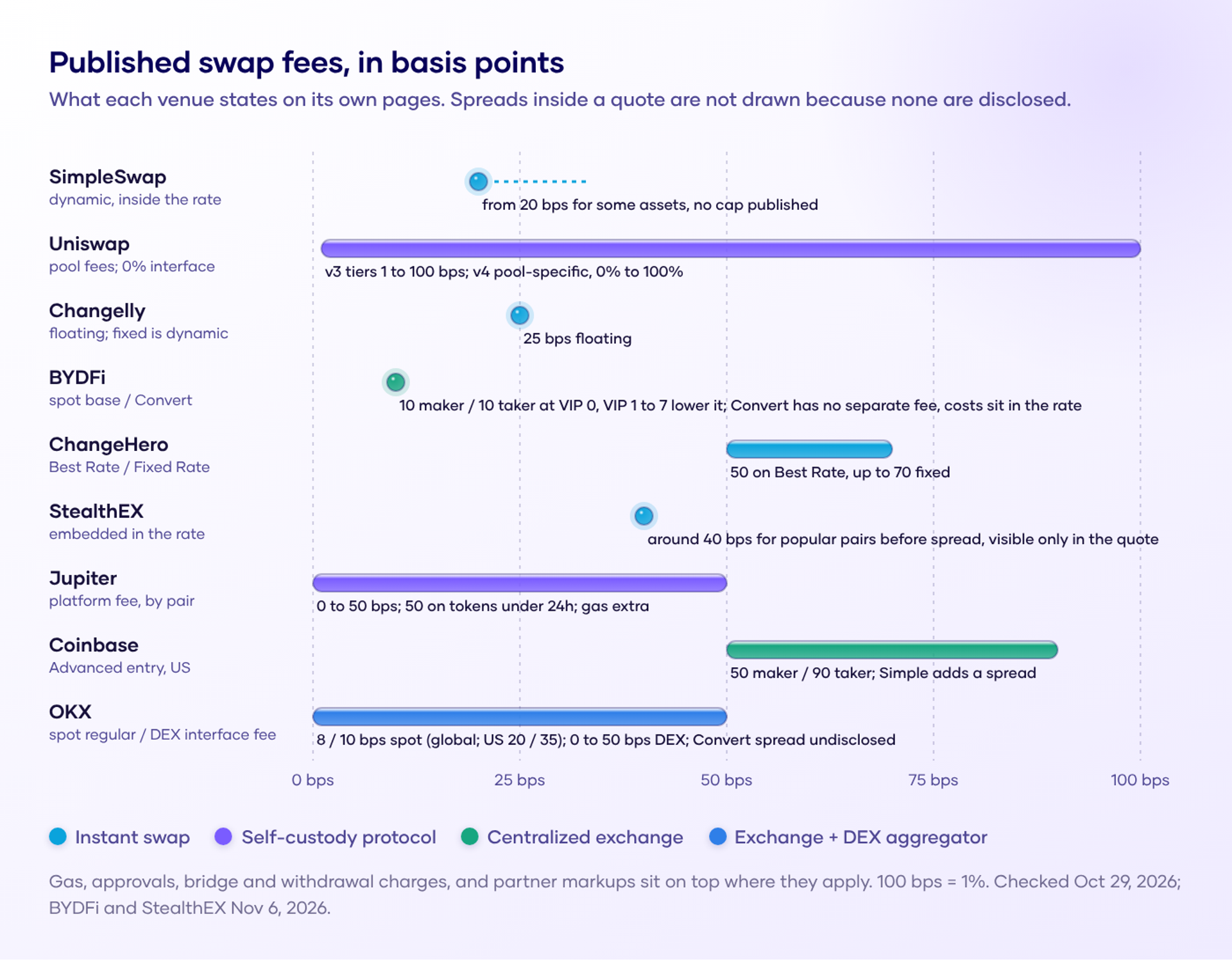
The chart above is the venues’ own published fees. The check in this section is what turns those numbers into a cost you can actually compare.
FAQ
Why do two swap exchanges quote different prices for the same pair?
Because they price it differently. A pool prices by how far the trade moves the ratio of its reserves, so impact grows with size. A book prices at the best resting ask, so the spread and the depth at that level set the cost. A route builds its quote from the sources it supports and adds its own fee. The quotes converge on liquid pairs and diverge on thin ones, which is why the fair yardstick is net executable output for the same input, direction, and size, checked against synchronized quotes.
Is a swap aggregator the same as a DEX aggregator?
Not quite. A DEX aggregator such as Jupiter or OKX DEX routes a signed onchain transaction across pools on one chain or a set of chains. A swap aggregator such as SimpleSwap routes across both centralized and decentralized providers and settles wallet to wallet through a deposit address, which lets it cross chains that no single pool connects. The first needs a wallet connection. The second does not.
Which crypto swap exchanges do not require KYC?
Seven of the nine can be used without an account, OKX through its DEX. On SimpleSwap, most crypto-to-crypto swaps are completed without identity verification, and additional verification may extend processing times. Changelly and ChangeHero run risk-based screening rather than upfront verification, and their AML policies allow document requests and holds; StealthEX holds transactions flagged by automated risk screening for verification. SimpleSwap, Changelly, and ChangeHero restrict certain locations in their terms, the United States among them. Uniswap, Jupiter, and OKX DEX ask for a wallet signature and apply their own front-end screening. Coinbase and OKX’s custodial side verify identity before the first trade; BYDFi requires it for fiat purchases and sales and for most rewards, and verification unlocks higher withdrawal limits.
Which swap exchange is cheapest?
Sorted by pricing engine, the published numbers look like this. Books: OKX’s global exchange starts at 0.08% maker and 0.10% taker (OKX US at 0.20% and 0.35%), BYDFi at 0.1% and 0.1%, and Coinbase Advanced at 0.50% and 0.90% in the US; BYDFi’s Convert charges no separate fee, with costs in the quoted rate. Curves: Uniswap’s v3 pools run 0.01% to 1% and v4 pools set their own rate, with no Labs interface fee but potentially additional protocol or hook fees; Jupiter’s platform fee runs 0 to 50 bps by pair. Routes: SimpleSwap’s fee starts from 0.2% for some assets and sits inside the rate, Changelly publishes 0.25% on floating swaps, ChangeHero publishes 0.5% flat, and StealthEX’s fee is embedded in the rate at around 0.4% for popular pairs before spread. None of these numbers settles the question, because the pair and the size decide what the quoted output looks like, gas, approvals, and withdrawal fees sit outside most of them, and a deep book at 0.10% often beats a thin pool at 0.01%.
How can a builder tell whether a venue’s quotes are competitive?
Compare net executable output for the same assets, direction, and size against synchronized quotes and order-book estimates from the venues where the pair trades, after fees and separately charged costs. The CoinAPI Market Data API exposes the per-exchange trades, quotes, and books for that, and the Exchange Rates API supplies a VWAP-24H reference for broader context, so the comparison can run continuously rather than once.
Summary
The nine venues in this guide are best understood as three pricing engines wearing nine interfaces. Curves (Uniswap, and the pools Jupiter routes through) charge in price impact. Books (BYDFi, Coinbase, OKX) charge in spread and a schedule, or fold the cost into a Convert quote. Routes (SimpleSwap, Changelly, ChangeHero, StealthEX, OKX DEX) charge in the provider’s markup. Pricing and custody are separate dimensions: what matters is whether a swap uses a user-controlled wallet, a provider deposit address, or an exchange balance, and some venues offer more than one of those paths.
The practical consequence is that a published fee is a weak predictor of what a swap costs. The most useful comparison is the net amount received for the same input asset and size, accounting for separately charged gas, approval, bridge, and withdrawal costs. The quoted output is only an estimate until execution, and competitiveness should be judged against synchronized executable prices from the relevant markets. That is also why the volume column is three measurements rather than one, why network counts differ by product, and why every figure in this guide carries a source and a date.
Whichever venue wins, the rate it shows is one number from one place. The market behind it is 400+ exchanges and hundreds of thousands of symbols moving at once. The CoinAPI Market Data API delivers that market as one normalized stream of trades, quotes, and order books, and CoinAPI Flat Files hold the history needed to test a routing strategy against it.
Explore the docs to see how the data fits a swap product.
👉 Get Your API Key and Start with Free Credits
Crypto API made simple: Try now or speak to our sales team
Start for Free · Get in Touch
Fees, network counts, and product facts in this guide were read from provider documentation on October 29, 2026 (BYDFi and StealthEX on November 6, 2026), and volumes from DefiLlama and CoinStats on November 4, 2026 (07:49 and 07:45 UTC); they will drift from those dates onward.
Disclaimer: this article is for informational purposes only and is not financial, investment, legal, or tax advice. Crypto assets are volatile, and swapping them carries market, counterparty, and smart contract risk. Nothing here is a recommendation to use any venue or to buy or sell any asset. Check each venue’s fees, availability, and terms in your jurisdiction before trading, and consult a licensed professional where appropriate.
Related Topics
- Best Solana APIs (2026): A Practical Guide for Builders
- Best Crypto APIs for AI Trading Bots, Quant Research & MCP Workflows (2026)
- Best Ethereum APIs - Simple Guide for Developers
- Best API Tools for Crypto Traders
- How to Reconstruct Hyperliquid L4 Order Books Correctly
- 5 Best RPC Node Providers in 2026 (Free + Paid)
- Best Financial Data APIs for Developers: 2026 Comparison